
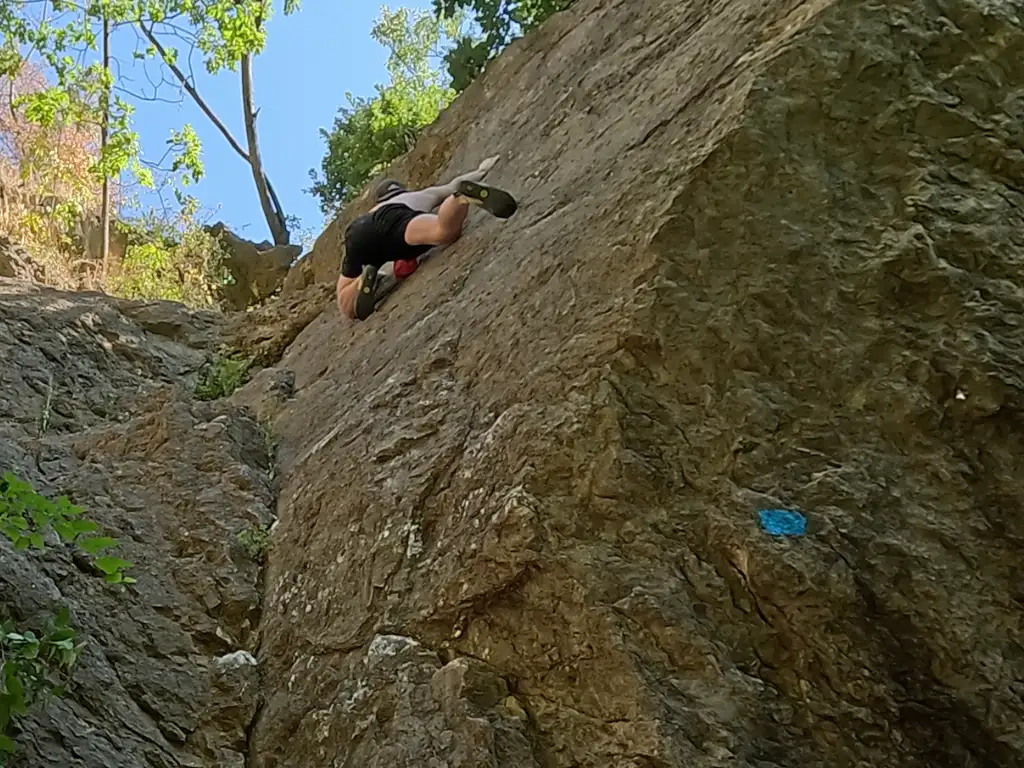
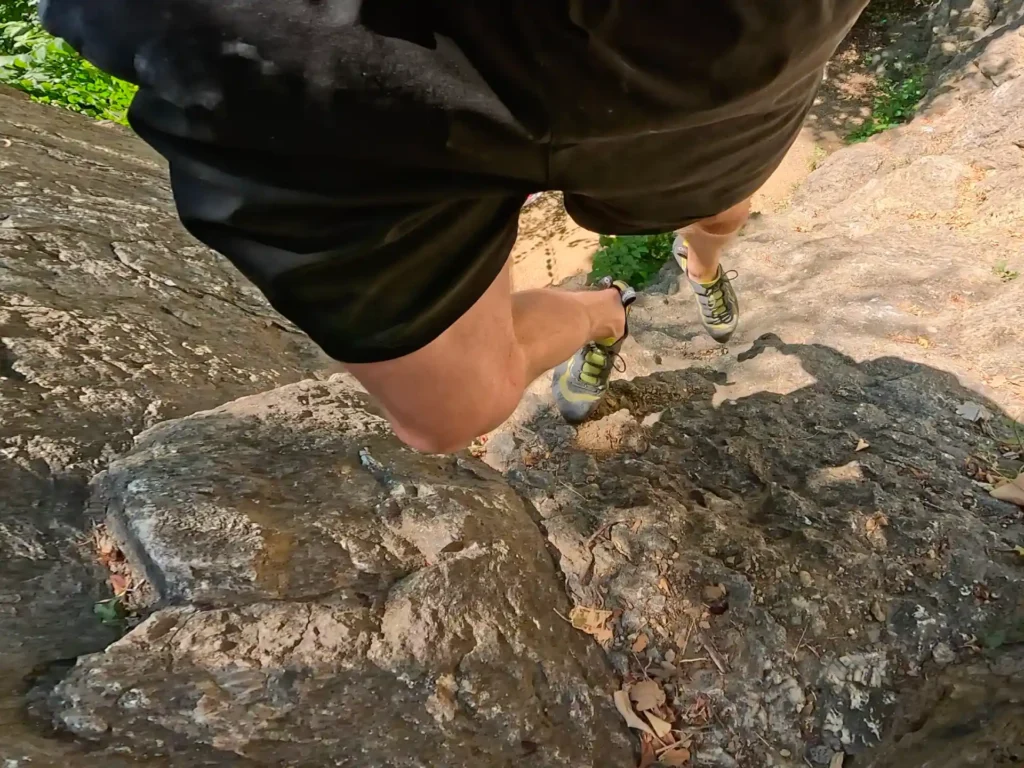
I came in from the top that day, found the boulder by descending a path beside it before I’d touched the wall. Looking down 15 meters of rock from above, before I’d climbed a single move, was nerve-racking in a way I didn’t expect. I wrote about that session already. Most people don’t approach a boulder from above. They walk up to the base, chalk up, start climbing. But the trigger is the same, the first time you look down mid-route and register how high you are, something happens in the brain that has nothing to do with technique or experience level. That reaction sat with me. I went looking for what the neuroscience of rock climbing actually says about it, and found more than I expected.
At a glance
Climbing at height increases energy cost by 14% even in advanced climbers, regardless of experience level (Frontiers in Psychology, 2020)
On-sight lead climbs produce significantly higher anxiety and post-climb lactate than a repeat ascent of the same route (Draper et al., PMC, 2012)
World-class climbers have measurably larger cerebellar and parietal brain structures than non-climbers on MRI (Di Paola et al., Human Brain Mapping, 2013)
Elite climbers don’t feel less fear. They have stronger prefrontal cortex control over what the fear signal makes the body do.
Table of Contents
Your Brain Detects Danger Before You Take the First Hold
The amygdala is a small, almond-shaped structure deep in the brain. Its job is threat detection, and it’s fast, subcortical, meaning it operates below the level of conscious thought and fires before any rational assessment could catch up. The moment height enters the picture, it starts scanning, distance to the ground, exposure, what happens if the hold fails. It doesn’t wait for permission. It doesn’t ask whether you chose to be here.
That’s what was happening when I looked down from the top of that boulder before I’d taken a single move. I didn’t decide to feel nervous. The amygdala ran its threat scan, height, exposure, drop below, no rope. The body responded accordingly. Heart rate up, attention narrowed, muscles primed. The question isn’t whether this happens. It’s what you do with it once it does.
fMRI research on Alex Honnold, the free solo climber who ascended El Capitan without a rope, found something worth understanding, his amygdala wasn’t absent or broken (BrainFacts.org, 2016). It activated at a lower threshold than a control climber of similar age. The difference isn’t fearlessness. It’s calibration, decades of exposure training the alarm system to activate less easily. That’s not a fixed trait. It changes.
The height effect is measurable regardless of experience. A 2020 study found that climbing at height increases energy cost by 14%, heart rate by 4.5%, and ventilation by 7.7% compared to climbing at ground level, and this held across all ability groups, including advanced climbers (Frontiers in Psychology). To put that in concrete terms: the same physical effort, on the same holds, burns 14% more energy when there’s a real drop below you. The body is doing extra work that has nothing to do with the climbing movement itself. The brain is processing the height, and that costs something.
The Stress Response Is Supposed to Help. Until It Doesn’t.
When the amygdala signals danger, the hypothalamus launches a coordinated response. Adrenaline releases. Heart rate rises. Muscles tighten throughout the body, not just the ones you’re using, all of them. Attention narrows to the immediate threat. For most of human evolutionary history, this was the right answer. Get ready to fight or run. Do it now.
Climbing needs something different. Precise foot placement. Controlled breathing. Smooth, deliberate movement through the fingers and hands. Fine motor coordination. Every one of these capabilities degrades under the fight-or-flight response, because survival mode tightens what climbing requires to be loose.
The clearest collision between these two systems is overgripping. Under stress, climbers grip holds harder than the holds actually require. It feels correct, hold on tighter, don’t fall. But it’s the stress response operating, not a technique decision. The forearms build pump faster. Muscles fatigue well ahead of their actual limit. You get pushed off the wall by your own nervous system, not by the difficulty of the route. Recognizing this as a stress response rather than a skill failure changes how you approach it.
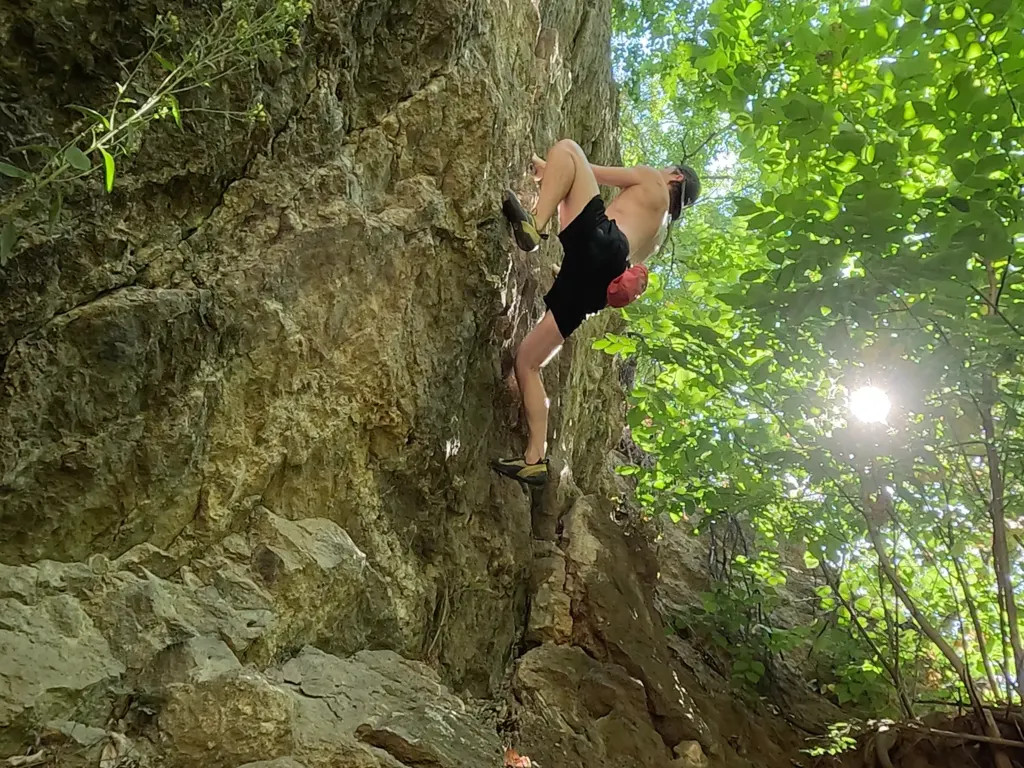
I felt it directly in the overhang. The holds were cracked, some shifting when I tested them, and I couldn’t trust them given the position I was in. The body responded to that uncertainty by gripping harder. Which accelerated the pump. Which narrowed my options faster than the route itself would have. A significant portion of that arm failure was the stress response compounding the physical effort, not just the physical effort on its own.
Researchers measured this in a 2012 study that sent intermediate climbers up the same 9.38-meter route twice, once as an on-sight attempt, once as a repeat of the same climb (Draper et al., PMC). They tracked anxiety using a standardized scale with two dimensions. The somatic subscale measures physical anxiety: the racing heart, the muscle tension, the shaky hands. The cognitive subscale measures mental anxiety: the “what if I fall” loop, the doubt, the distraction. Both run from 9 to 36. Nine is completely calm. Thirty-six is maximum anxiety.
On the first ascent, somatic anxiety averaged 17.7. On the repeat of the same route, same holds, 14.3. Cognitive anxiety dropped from 22.6 to 19.0. Post-climb lactate was also significantly higher after the on-sight, meaning the body worked harder at comparable heart rates. Simply having climbed the route once before, knowing what was coming, measurably reduced the stress response. The brain’s reading of the situation changes the body’s physical output. They’re not separate systems.
A broader framework from antifragility research in climbing describes three performance zones: too easy (stress is minimal, no meaningful adaptation), challenging (stress is productive, performance improves), and exceeds capacity (stress is excessive, performance degrades) (Frontiers in Psychology, 2020). Rigid movements, overgripping, poor balance, faster fatigue, more errors. These all appear past the optimal stress threshold. The climbing zone sits between the extremes. Past it, the stress response stops being useful.
What Your Motor System Is Actually Doing Mid-Route
While the amygdala is running its alarm, a separate set of brain systems is handling its own computation. The motor cortex plans and initiates movement sequences. The cerebellum continuously adjusts balance, timing, and coordination, correcting visuomotor errors before you’re aware of them. The parietal lobe integrates sensory input, manages spatial orientation, and handles proprioception, knowing where your body is in space without having to look.
These systems don’t pause when the stress response activates. They run in parallel. Most activities engage either the survival system or the precision motor system. Climbing engages both simultaneously, in direct competition with each other.
The blind reach above the overhang made this concrete. I couldn’t lean back far enough to see the holds, the geometry of the overhang wouldn’t allow it. So I reached past my sightline and read the rock by touch, texture, edge shape, whether it would take weight. The parietal lobe building a spatial map from touch when vision isn’t available. I found three edges before one felt different, more solid. The information was there. I just couldn’t see it.
The leg jam in the crack worked the same way. I didn’t plan it as a technique call. The body found a crack to the left, pressed the leg in, shifted weight, and the arms unloaded. The cerebellum accepted the proprioceptive input, adjusted weight distribution across the position, and calculated relief. Not a decision. The motor system solving a problem I hadn’t consciously posed.
Research on world-class climbers shows how deep the motor adaptations go. A 2013 MRI study compared 10 elite climbers with 10 age-matched non-climbers (Di Paola et al., Human Brain Mapping). The climbers showed significantly larger vermian lobules I-V, a specific cerebellar region tied to dexterous hand movement and real-time visuomotor error correction. They also had enlargement in the right medial posterior parietal area, the region that predicts the sensory consequences of movement. These differences weren’t functional observations. They were visible on a structural scan. The brain that climbs regularly is a physically different structure than the brain that doesn’t.
The cerebellum in particular is worth noting. It’s not just correcting balance. It’s running predictions: here is where the limb is, here is where it needs to be, here is the adjustment to close the gap, all before conscious awareness catches up to what the body just did.
Fear Regulation, Not Fear Elimination
Going back to the crack three or four times wasn’t a strategy I came up with. My arms would give out, I’d find the leg jam and rest, recover enough to reach up again, test holds that weren’t solid enough to commit to, and return. I wasn’t consciously managing fear. I was managing forearm pump. But looking at it through what I read afterward, that’s what active fear regulation actually looks like from inside it.
The prefrontal cortex, responsible for rational assessment, decision-making, and impulse control, sends inhibitory signals to the amygdala when it has enough information to work with. It doesn’t silence the alarm. It overrides the alarm’s motor output, keeps the body moving despite the signal instead of freezing or retreating. Experienced climbers maintain stronger prefrontal cortex control under pressure. Not a quieter amygdala. Better override.
Free solo changes this calculation significantly. Without a rope, the amygdala’s alarm is louder because the fall is real. The same wall, the same holds, but the fear signal isn’t buffered by the knowledge that the rope catches you. The prefrontal cortex faces a harder override job. That’s why even after I committed to the hold I’d been testing, the next four or five moves were still uncomfortable. The alarm hadn’t resolved. I’d just decided to keep moving anyway.
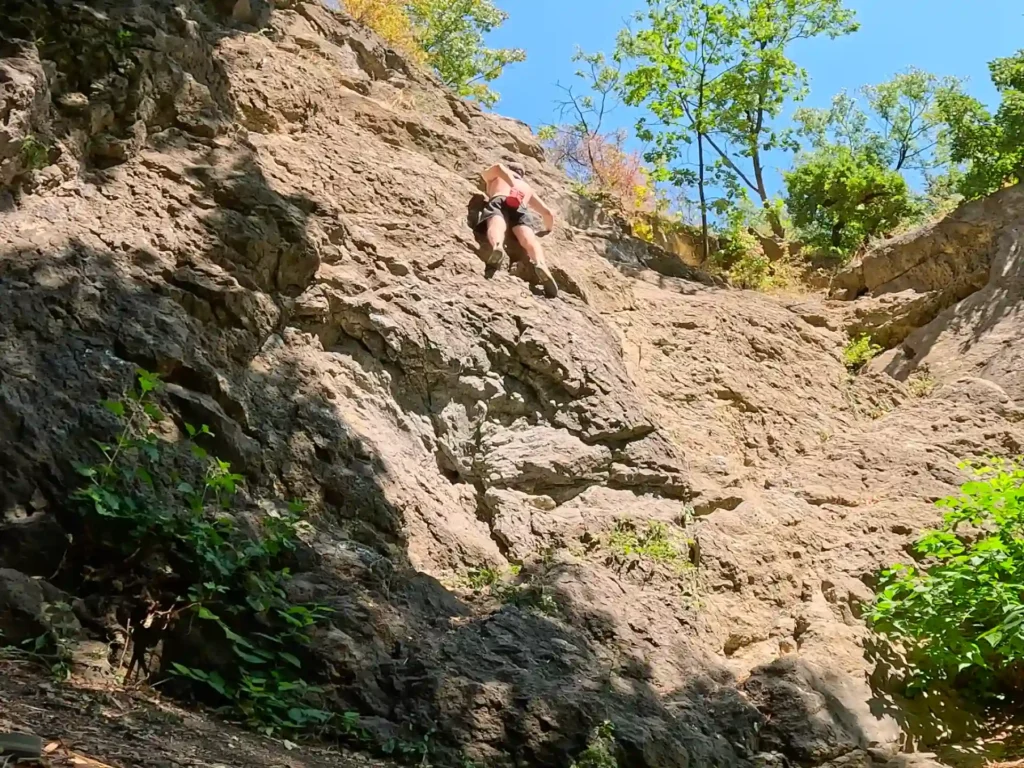
The goal was never to stop being afraid on that wall. Sports psychology research on fear and performance makes this clear, elite climbers don’t stop feeling fear. They feel it and keep climbing. The distinction matters because it reframes what a good session looks like. Feeling afraid mid-route isn’t a sign something went wrong. It’s the amygdala doing its job. The question is whether the prefrontal cortex gets to make the call about what happens next.
The mental health benefits of high-stakes outdoor sport connect here in a way I didn’t initially expect. A 2022 study found rock climbing therapy was equally effective as cognitive behavioral therapy for treating depression (Luttenberger et al., via Knowing Neurons). CBT is one of the most validated psychological treatments in clinical practice. Climbing matched it. The mechanism researchers point to is the repeated cycle of confronting fear and regulating it rather than avoiding it, building prefrontal cortex override capacity through practice, until the brain learns it can keep functioning even when the alarm is running.
Every Route Trains Both the Body and the Brain
That session happened once. The brain doesn’t process a hard afternoon and move on unchanged. It adapts, and climbing gives it a lot to adapt to.
The structural changes in world-class climbers, the larger cerebellar vermis and the enlarged parietal area, came from accumulated sessions, not one climb. The brain that has climbed ten thousand routes is a physically different object than the one that hasn’t. That’s visible on a scan. Not a metaphor.
Beyond structure, climbing promotes elevated levels of brain-derived neurotrophic factor, or BDNF, a protein that supports communication between neurons, encourages the growth of new connections, and contributes to long-term neural health (Knowing Neurons). BDNF is part of why sustained exercise produces cognitive and mental health benefits generally. Climbing appears to generate it at meaningful levels, which is part of why the depression findings hold up. The brain isn’t just distracted from depression by climbing. It’s being chemically supported toward recovery.
The transferable skills are worth naming. Attention control, staying focused on an immediate problem while fear and fatigue try to pull attention away. Adaptive problem-solving, no two routes present the same sequence, and the body gets better at generating solutions under pressure. Decision-making in uncomfortable states, when to commit, when to rest, how much risk is actually acceptable given what you can feel under your fingers. These aren’t narrow climbing skills. They develop through climbing and they don’t stay on the wall.
I’ve spent years trying everything rather than specializing in one thing, and that’s the core of how I approach sport. What I hadn’t considered before looking into this is that variety across disciplines keeps the brain in novel territory, which is where adaptation happens at the highest rate. Climbing earns its place in that rotation precisely because it forces so many systems to run at once, under conditions that are genuinely hard to replicate elsewhere.
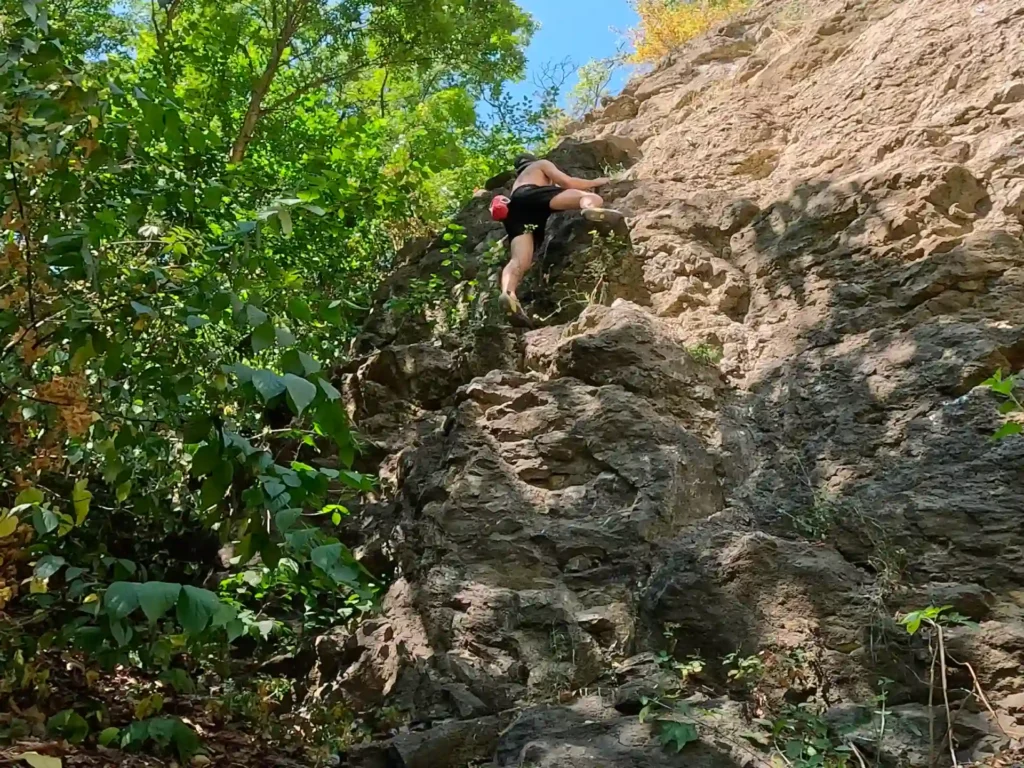
I didn’t go to that boulder to train my brain. I went because it was Sunday, the rock was there, and I’d been looking at it on a map long enough. Still the right reason to go.
After topping out I sat down for a couple of minutes. That’s the parasympathetic nervous system downshifting: heart rate dropping, muscle tension releasing, the alarm resolving after the threat passed. Time alone in the forest does something to the nervous system that’s hard to replicate indoors, and the recovery after a hard climb is part of that. The amygdala fired. The motor system computed. The prefrontal cortex eventually made the call to commit. The body kept moving. This is what every climber’s brain does on every route, at every grade. The brain doesn’t simplify as you get better at climbing. You just get better at working with it.
Frequently Asked Questions
Why do climbers overgrip under stress?
The fight-or-flight response tightens muscles throughout the body, including the forearms. Climbers grip harder than holds require, not because of poor technique, but because the stress response is doing exactly what it evolved to do: prepare the body to hold on and not let go. The result is accelerated arm pump and faster fatigue. Recognizing overgripping as a stress response rather than a technique mistake is the starting point for managing it on the wall.
Does rock climbing change your brain?
Yes, measurably. A 2013 MRI study by Di Paola et al. compared 10 world-class climbers with 10 age-matched non-climbers and found significantly larger cerebellar vermis I-V and right medial posterior parietal areas in the climbers (Human Brain Mapping). These regions handle dexterous hand movement and real-time visuomotor correction. The differences were structural, visible on a scan. Prolonged climbing leaves a physical mark on the brain.
Are elite climbers less afraid?
No. fMRI research on Alex Honnold found his amygdala still activates in response to fear stimuli. It just activates at a lower threshold than a control climber of similar age, likely recalibrated through years of exposure (BrainFacts.org, 2016). Elite climbers don’t stop feeling fear. They develop stronger prefrontal cortex control over what the fear signal makes the body do. The alarm still fires. They’ve gotten better at not letting it make the final call.
Why is rock climbing effective for mental health?
A 2022 study found rock climbing therapy was equally effective as cognitive behavioral therapy for treating depression (Luttenberger et al., via Knowing Neurons). CBT is among the most validated treatments in clinical practice. The proposed mechanism is the repeated cycle of confronting and regulating fear in a controlled context, building prefrontal cortex override capacity over time, alongside elevated BDNF supporting neural plasticity. The fear regulation component appears to be load-bearing, not just the physical exercise.
What makes free solo climbing neurologically different?
A rope partially buffers the amygdala’s alarm by removing the real consequence of falling. The brain registers the safety even when it’s not consciously acknowledged. Free solo removes that buffer entirely. Same holds, same route, but the fear signal is louder and the prefrontal cortex faces a harder override demand. This is why a route you can technically climb still feels categorically more intense without protection. The movement is the same. The neuroscience running underneath it isn’t.
Sources:
- Fryer, S. et al. (2020). Psychophysiological Responses to Rock Climbing at High vs. Low Walls in Experienced Climbers. Frontiers in Psychology. frontiersin.org
- Draper, N. et al. (2012). Tempo and the on-sight rock climbing performance of advanced climbers. Journal of Human Kinetics / PMC. pmc.ncbi.nlm.nih.gov
- Di Paola, M. et al. (2013). Cerebellar volumetry in world-class rock climbers. Human Brain Mapping. onlinelibrary.wiley.com
- BrainFacts.org (2016). No Fear: The Story of Alex Honnold’s Brain. brainfacts.org
- Draper, N. et al. (2020). Antifragility in climbing: a model for optimal performance. Frontiers in Psychology / PMC. pmc.ncbi.nlm.nih.gov
- Knowing Neurons. Can Rock Climbing Change Your Brain? (Luttenberger et al., 2022 referenced within.) knowingneurons.com

Filip Petreski is the founder of AFIELD and a multi-sport outdoor athlete. A two-time national cross-country MTB champion, snowboard instructor, and former dirt bike rider, he writes about the people, gear, and culture worth paying attention to in the outdoor world.