
Cold water immersion cuts pain scores nearly in half within 48 hours, per a 2025 PLOS One RCT. Here’s exactly how to start , temperature, duration, frequency.
You finish a hard ride, a long run, or a day on the mountain. Your legs are wrecked. You’re stiff, sore, and you already know tomorrow’s going to hurt. Cold plunging is the fastest, cheapest recovery tool most outdoor athletes aren’t using yet and the science behind it gets harder to argue with every year.
A 55-trial network meta-analysis published in Frontiers in Physiology (2025) confirmed that cold water immersion at 52-59°F (11–15°C) for 10–15 minutes is the most effective recovery protocol for reducing delayed-onset muscle soreness across 1,139 athletes. That’s not an influencer’s take. That’s controlled conditions, replicated.
Here’s exactly how to start:
Key Takeaways
- 10–15 minutes at 52–59°F (11–15°C) is the most effective cold plunge protocol for reducing muscle soreness, per a 55-RCT meta-analysis (Frontiers in Physiology, 2025).
- Cold water immersion drops pain scores nearly in half within 48 hours compared to massage (PLOS One, 2025).
- Immersion at 57°F (14°C) triggers a 530% spike in norepinephrine and 250% spike in dopamine effects lasting roughly 2 hours (European Journal of Applied Physiology).
- Just 11 minutes of weekly cold exposure can trigger measurable mood and metabolic benefits.
What Does Cold Plunging Do to Your Body?
Cold water immersion triggers a cascade of responses that go well beyond “it feels cold.” Within seconds of entering the water, your body releases norepinephrine and dopamine at levels you won’t hit in any other natural activity.
A study published in the European Journal of Applied Physiology found that immersion at 57°F (14°C) produces a 530% increase in plasma norepinephrine and a 250% spike in dopamine above baseline, effects that persist for approximately two hours (PubMed, 2000). That’s why you feel sharp, alert, and almost weirdly calm after a plunge. Your nervous system just got a hard reset.

On the physical side, cold water immersion reduces the inflammatory markers produced during intense training. It constricts blood vessels, reduces tissue swelling, and accelerates clearance of metabolic waste from muscles. When you get out, blood rushes back in, flushing the area and speeding recovery at a rate passive rest simply can’t match.
Real talk: The first time you step in, none of this matters. Your brain will scream at you to get out immediately. That feeling passes within 30–60 seconds. Knowing that in advance is half the battle.
According to a 2025 PLOS One meta-analysis of 11 randomized controlled trials (3,177 participants), cold water immersion produces a significant reduction in stress hormones 12 hours post-immersion (PLOS One, 2025). The body responds to cold stress with the same adaptation mechanisms it uses to respond to training stress, controlled exposure leads to real measurable change.
What Temperature and How Long? The Numbers That Actually Matter
The sweet spot for muscle soreness reduction is 52–59°F (11–15°C), held for 10–15 minutes. That’s the top-ranked protocol from the 2025 Frontiers in Physiology meta-analysis across 55 randomized controlled trials. For reducing muscle damage markers and preserving power output, 41–50°F (5–10°C) at the same duration edges ahead (Frontiers in Physiology, 2025).
Don’t rush the progression. Going too cold too fast is how people quit after session two. Two minutes at 59°F (15°C) done consistently beats one brutal plunge you never repeat.
One thing most beginner guides skip: get out before the timer goes off, not when it does. Choosing to exit on your terms, not because you bailed, it reinforces that you’re in control. That psychological rep matters more than the extra 30 seconds.
How to Do Your First Cold Plunge
You don’t need a $5,000 recovery tub. A bathtub with ice bags or a cold lake works. Here’s how to run your first session.

Before you get in
- Set your target before you start, pick a temperature and time you’re committing to. Ambiguity kills sessions.
- Prepare your exit, towel, warm layers, and a hot drink within arm’s reach.
- Take three slow breaths, in through the nose, long exhale through the mouth. You’re priming your nervous system, not psyching yourself up.
Getting in
- Enter slowly. Feet first, then legs, then lower body. Don’t jump.
- Once submerged to the shoulders, focus on your breathing. In through the nose, out through the mouth. The urge to gasp is normal, it passes in 30–60 seconds. Work through it.
- Keep your hands in. Full immersion drives a significantly stronger response than dangling them out.
Staying in
- Find a focal point, a spot on the wall, a breath count, anything steady. Don’t watch the clock.
- If you’re plunging with someone, talk. Conversation regulates the nervous system faster than silence.
Getting out
- Exit calmly. Don’t rush.
- Dry off and layer up before your core temperature drops further.
- Move, a short walk or light movement accelerates rewarming naturally. Skip the immediate hot shower. Let your body do the work.
How Often Should You Cold Plunge for Recovery?
Research cited by NutritionFacts.org (2024) and based on Soeberg (2021) suggests as little as 11 total minutes per week at or below 59°F (15°C) is enough to see measurable mood and metabolic benefits. That breaks down to three or four sessions of two to three minutes each.
For athletic recovery specifically, 2–4 sessions per week, timed within 1–2 hours post-training, is where the research points. Daily plunging is safe but likely unnecessary, your body needs time to adapt and extract the benefit from each session.
One timing note worth knowing: if you’re deep in a strength-building block, cold plunging immediately post-resistance training may blunt some muscle adaptation signalling. For endurance athletes and multi-sport outdoor athletes, this tradeoff is minimal. The recovery benefit outweighs it. If you’re specifically chasing strength gains, time your plunges 4+ hours after lifting.
AFIELD take: For most action sports athletes, mountain bikers, trail runners, snowboarders, the risk of under-recovering is far greater than the risk of blunting hypertrophy. Cold plunge after your session. Worry about the nuance when you’re competing at a level that makes the nuance matter.
Cold Plunge vs Cold Shower – Is There Actually a Difference?
Yes, significantly. A 2025 PLOS One meta-analysis (3,177 participants, 11 RCTs) showed full-body cold water immersion produces a measurable reduction in stress hormones 12 hours post-exposure (PLOS One, 2025). The same review found 29% fewer sick days in cold shower users over 30 days, so showers have value, but the physiological response from full immersion is in a different category.
The difference is surface area. Full-body immersion activates far more thermoreceptors simultaneously, driving a stronger sympathetic nervous system response. A two-minute cold shower switches the system on. A ten-minute cold plunge trains it.
Cold showers are a legitimate entry point, especially if you’re building the habit or don’t have access to a tub. But they’re a ramp, not the destination.
Safety – What to Know Before You Start
Cold water immersion is safe for healthy adults. A few things worth knowing first:
- Don’t plunge alone for your first sessions. Cold shock response can cause involuntary gasping and disorientation in unfamiliar conditions.
- Cardiovascular conditions, check with a doctor before starting. The blood pressure response to sudden cold immersion is significant.
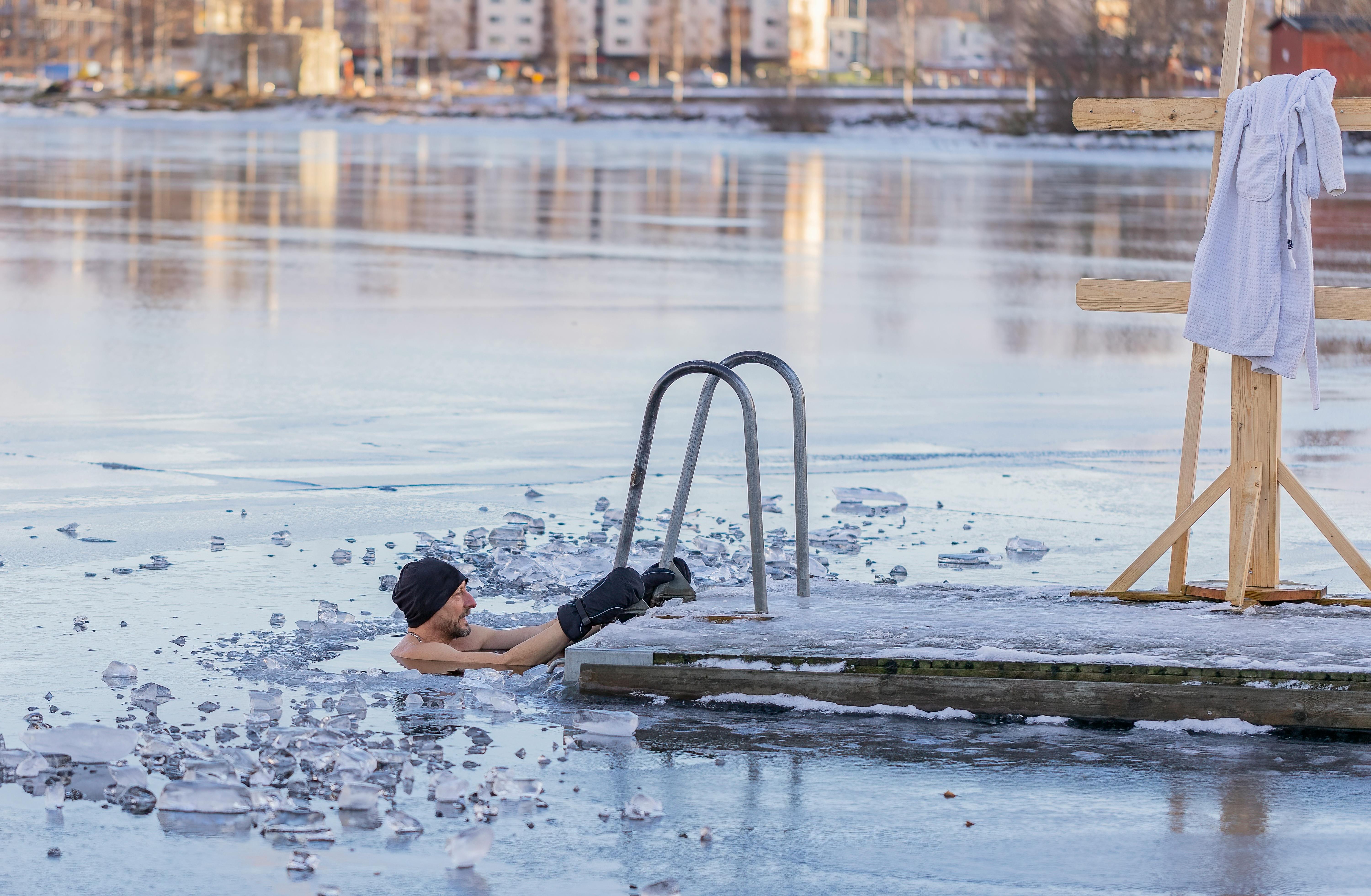
- Open water, never cold plunge in a natural lake or river alone. Cold water incapacitation is fast and unpredictable.
- Watch for this warning sign, shivering is your body generating heat. If it stops and you feel warm or sleepy, get out, that’s a dangerous drop in core temperature.
Start in a controlled environment. A bathtub with ice bags is safer than a frozen lake for session one. Earn the outdoor session.
Frequently Asked Questions
How cold should a cold plunge be for beginners?
Start at 15°C (59°F) for your first sessions. A 2025 meta-analysis in Frontiers in Physiology found 52-59°F (11–15°C) is the most effective temperature range for reducing muscle soreness across 1,139 athletes in 55 controlled trials. Drop the temperature gradually over weeks as you adapt and get comfortable with the breath.
How long should I stay in a cold plunge?
10–15 minutes is the sweet spot for athletic recovery, per the 55-trial network meta-analysis (Frontiers in Physiology, 2025). Beginners should start at 2–3 minutes and build up progressively. Duration matters more than temperature when you’re just starting, consistency beats intensity.
Should I cold plunge before or after a workout?
Post-workout is the primary use case. Cold water immersion reduces inflammation and clears metabolic waste produced during training. Pre-workout cold exposure can sharpen alertness but may reduce peak power output. Use it after for recovery. Reserve pre-workout cold for days you need a mental edge, not physical output.
Can I cold plunge every day?
Yes, daily plunging is safe for most healthy adults. Research suggests 2–4 sessions per week is sufficient for measurable recovery benefit, with as little as 11 total minutes weekly shown to produce mood and metabolic improvements. More frequent isn’t necessarily better, give each session room to work.
Is a cold shower the same as a cold plunge?
No. Full-body immersion activates significantly more thermoreceptors simultaneously and produces a far stronger physiological response, including larger increases in norepinephrine and dopamine. A 2025 PLOS One meta-analysis (3,177 participants) confirmed this difference across multiple outcomes. Cold showers are useful as a starting point, but they deliver a fraction of the recovery and neurological benefit of full immersion.
The Cold Won’t Kill You. Avoiding It Might
Cold plunging isn’t complicated. The protocol is simple: get in, breathe through the first minute, stay for the time you committed to, get out. Do it two to four times a week after your hardest sessions.
The hardest part isn’t the cold. It’s the ten seconds before you step in. Once you’re submerged, the body takes over and within 60 seconds you’ll understand why athletes who start almost never stop.
Start at 59°F (15°C). Stay for two minutes. See what happens.

Filip Petreski is the founder of AFIELD and a multi-sport outdoor athlete. A two-time national cross-country MTB champion, snowboard instructor, and former dirt bike rider, he writes about the people, gear, and culture worth paying attention to in the outdoor world.