
There’s a point on a fast, technical trail where the brain runs out of room for anything else. The unfinished list, the conversation from this morning, whatever has been sitting there half-resolved goes quiet because the riding takes everything. I’ve felt this since I was racing cross-country mountain bikes, where every position I gained came on the descents and technical sections, not the uphills. I noticed the same thing on my dirt bike, which spent far more time on enduro terrain than any mx track. At some point I wanted to understand what was actually happening. The research on flow state outdoor sports is clear enough to explain it.
At a glance
Going fast isn’t about adrenaline. When a task demands 100% of your attention, background noise (worry, rumination, stress) has no bandwidth left to run. A 20-minute motorcycle ride reduced cortisol (the body’s main stress marker) by 28% in a UCLA brain study. Here’s what the research on flow state outdoor sports actually explains.
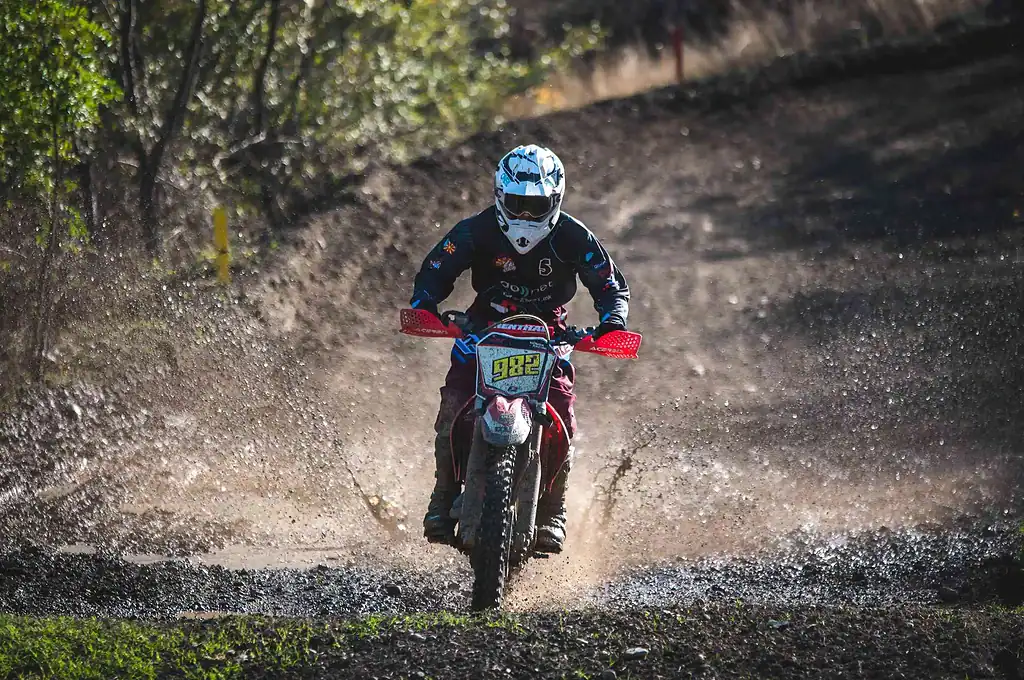
Table of Contents
The Brain Has a Noise Problem. Speed Solves It.
There’s a researcher named Mihaly Csikszentmihalyi who spent decades mapping what he called flow state. The condition is specific, a task demands exactly as much as you have to give, and the part of your mind that worries, plans, and second-guesses goes quiet. He studied chess players, surgeons, musicians. The condition showed up the same across all of them. A 2022 analysis that pooled 252 separate studies confirmed the trigger, challenge matched exactly to skill is the single most consistent condition across every context ever measured (Frontiers in Psychology, 2022).
The balance matters in a specific way. Too easy and the brain starts opening its other drawers, running the background list. Too hard and it locks up. Matched exactly to what you can actually handle, it locks in. Speed gets there efficiently because it stacks multiple demands at the same time: reading the terrain ahead, predicting the next three seconds, adjusting weight, managing grip, reacting. Every channel gets occupied at once, and when all of them are in use, the brain has nothing left to run in the background.
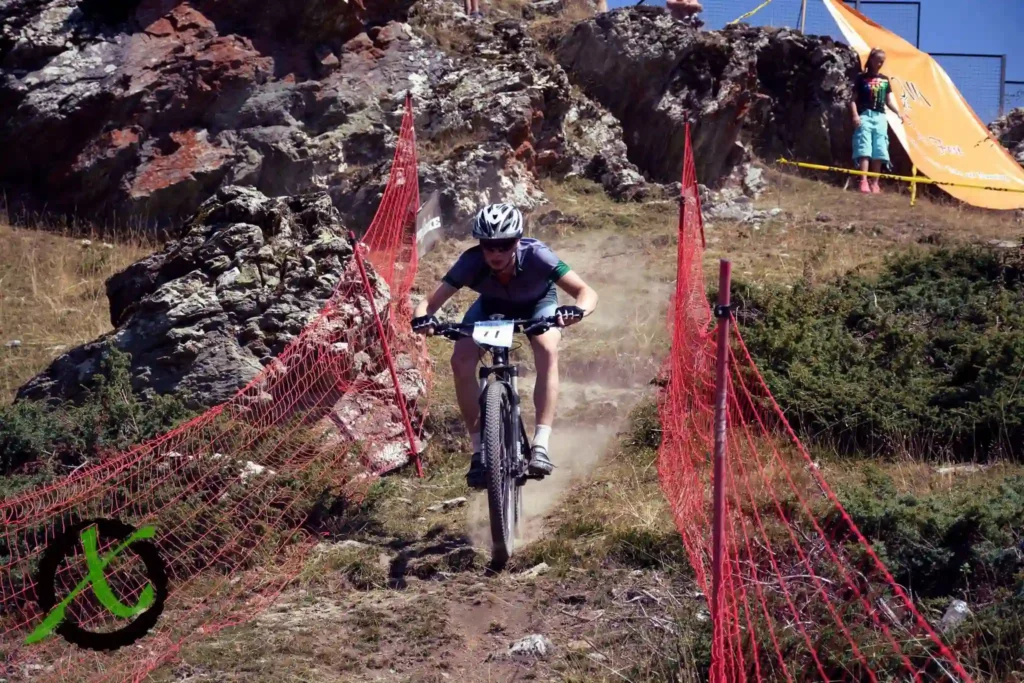
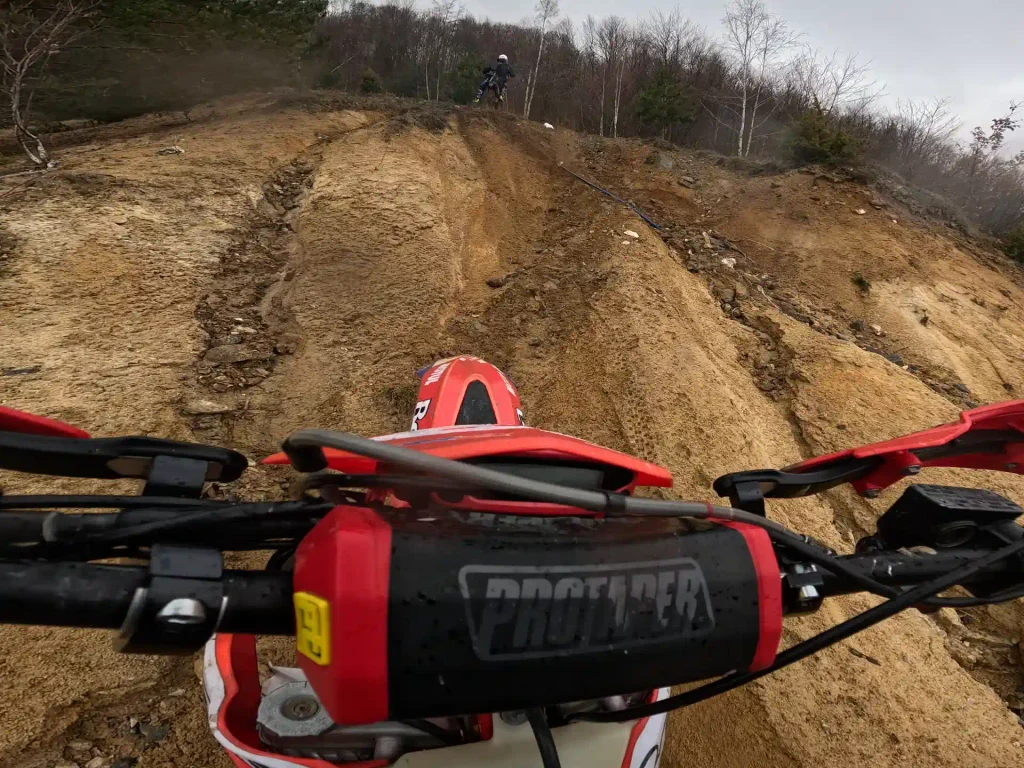
In cross-country racing, the uphills were where fitness decided things. They were never my moment. Every position I made in races came on the descents and the technical sections, partly because that’s where I was comfortable, but also because probably that’s where the brain fully committed and stopped running anything else. I didn’t have words for the mechanism at the time. On a dirt bike it was the same, steep and rocky terrain, the bike demanding constant input across throttle, clutch, body position, line choice, weight shifting through corners. The moment it asked for all of it at once, everything else went quiet. That’s what riding across multiple disciplines does, it keeps showing you the same thing on different machines, which eventually makes it impossible to ignore.
What Actually Turns Off When You Go Fast
When physical demand gets high enough, the part of the brain responsible for self-criticism, planning, and second-guessing temporarily steps back, not because of any decision but because the load left it no capacity. NIH researchers documented this in 2008 while studying jazz musicians mid-improvisation, when the musicians played freely, the regions handling planning and self-monitoring went quiet while the regions handling movement and real-time response became more active (BrainFacts.org, citing Limb & Braun, NIH, 2008). A 2026 systematic review of nine separate brain imaging studies confirmed the same pattern holds across contexts, during flow states, the brain’s worry-and-rumination network gets suppressed, and that suppression correlates directly with the disappearance of self-referential thought (Frontiers in Behavioral Neuroscience, 2026).
What goes quiet is specific. The inner critic steps back, the part that monitors how you’re doing and runs a loop of things you should have handled differently. Speed does this faster than most other challenges because it adds a full physical layer that cognitive tasks alone don’t carry. Managing body position, absorbing terrain, maintaining grip, these pull processing from parts of the brain that normally run quietly during mental-only work. The total load is higher, and the step-back happens sooner.
I’ve watched Mario Roman ride hard enduro sections where the terrain would stop most riders. Nothing about how he moves looks urgent. You feel it before you can explain it. Billy Bolt has the same quality. The research gives it a name, the second-guessing part of the brain has stepped back. What’s left is just the riding.
Why a 30-Second Trail Section Feels Like a Minute
Everyone who rides fast knows this. A section that takes 30 seconds plays back in memory as longer, with more detail than any ordinary 30-second stretch would have.
The brain’s emotional memory center stores more detail per second when intensity is high. More detail per second means more material when you replay it. A 2020 study in Experimental Brain Research measured this precisely, researchers found that high-arousal experiences produced significant time overestimation compared to low-arousal ones. The correlation between arousal level and how much participants stretched the duration was r = 0.66 out of a maximum of 1.0 (Experimental Brain Research, 2020). About two-thirds of arousal’s effect on the brain shows up directly as expanded time perception. For perception research, that’s a strong number, strong enough to hold consistently across subjects and conditions.
I can still describe specific lines from descents I raced years ago, the exact point where I had to hold off the brake, a rut I went left of, the way a particular corner opened wider than its entry suggested. That level of detail for something that lasted half a minute isn’t an unusually good memory. It’s what happens in the brain when the stakes are real, the recording runs at a higher rate. The faster and more intense the moment, the more material gets stored per second, and the more there is when you play it back.
What Does the Research Actually Show?
Three studies worth knowing.
A UCLA researcher put 50+ experienced motorcycle riders on bikes with mobile EEG equipment and cortisol monitors. Cortisol is the body’s primary stress marker, the thing that stays elevated when pressure doesn’t ease. After 20 minutes of riding on regular city streets, cortisol dropped 28%. Heart rate went up 11%. The brain became more focused at the same time stress went down. The study was funded by Harley-Davidson, which is worth knowing. The methodology holds up regardless, mobile EEG, validated cortisol biomarkers, published in Brain Research (UCLA / PR Newswire, 2021).
A survey asked 1,484 mountain bike riders three separate questions about why they ride. Do everyday worries fade while riding? 93.5% said yes. Do you use it to de-stress? 90.2% said yes. Does it help with negative thoughts? 82.1% said yes. (Frontiers in Psychology, 2018). Nearly 1,500 people, three different questions, all pointing the same way.
The third study challenges the most common assumption about why people go fast. A 2025 study of 75 motorcycle racers found that flow state and sensation-seeking (the drive to pursue thrills for the hit itself) showed no significant correlation. They’re separate things (Frontiers in Psychology, 2025). The people going fast aren’t a different category of person wired for risk. They found something that quiets the noise, and they kept going back for it.
Frequently Asked Questions
What is flow state in outdoor sports?
Flow state is full cognitive absorption: a task demands 100% of your attention, self-consciousness drops, and the brain’s worry-and-rumination network goes quiet. It’s triggered when the challenge matches the skill exactly. In outdoor sports, speed stacks enough simultaneous demands to trigger it efficiently. A 2022 analysis of 252 flow state studies confirmed challenge-skill balance as the most consistent trigger across all contexts.
Why does going fast feel calming?
Because the part of your brain responsible for second-guessing and worrying temporarily steps back when physical demand is high enough. A 2026 review of nine brain imaging studies confirmed that the brain’s worry-and-rumination network gets suppressed during flow states. There’s no bandwidth left for anything else.
Why does time feel slower when you’re going fast?
The brain’s emotional memory center stores more detail per second during intense experiences. More detail stored means more subjective duration when you recall it. A 2020 Experimental Brain Research study confirmed that high-arousal experiences produce statistically significant time overestimation, with a correlation of r = 0.66 between arousal level and how much time gets stretched in perception.
From the outside, speed reads as risk, something you’d have to be wired differently to enjoy. The default explanation is adrenaline, and it misses most of what’s actually going on.
Across mountain bikes and a dirt bike, on different terrain and asking for different inputs entirely, the same thing kept happening, the moment the demand exceeded a certain point, the brain stopped opening other drawers. The research on flow state outdoor sports puts a name and a mechanism to something I had been experiencing for years without being able to explain it. That’s why people keep choosing hard situations. And it’s what it looks like in someone who’s had enough practice that the quiet shows in how they move.
Sources
- Huskey, R. et al. “A Mechanistic Account of the Flow Experience.” Frontiers in Psychology, 2022. Challenge-skill balance across 252 studies.
- Limb, C. & Braun, A. “Neural Substrates of Spontaneous Musical Performance.” NIH, 2008. Via BrainFacts.org — transient hypofrontality during improvisation.
- Ulrich, M. et al. “Neuroscience of Flow States.” Frontiers in Behavioral Neuroscience, 2026. DMN suppression during flow — 9 brain imaging studies.
- Noulhiane, M. et al. “Time perception under high arousal.” Experimental Brain Research, 2020. r = 0.66 correlation between arousal and time overestimation.
- UCLA Brain Research / Harley-Davidson. “Riding a Motorcycle Improved Metrics of Focus and Decreased Stress Biomarkers.” PR Newswire, 2021. Cortisol −28%, heart rate +11% after 20-min ride.
- Grabow, M. et al. “Mountain biking and mental health.” Frontiers in Psychology, 2018. Survey of 1,484 riders — 93.5% say worries fade while riding.
- Chiou, W. et al. “Flow state and sensation-seeking in motorcycle racers.” Frontiers in Psychology, 2025. No significant correlation between flow and thrill-seeking.

Filip Petreski is the founder of AFIELD and a multi-sport outdoor athlete. A two-time national cross-country MTB champion, snowboard instructor, and former dirt bike rider, he writes about the people, gear, and culture worth paying attention to in the outdoor world.