
It rained the whole time we were on Cer. About ten of us had driven out from Belgrade in a few shared cars, most of the people I was meeting for the first time, and while everyone talked, I kept looking at the ground. What trees are these, how old is this forest, could porcini grow here. The group already had a name for me, the Macedonian guy who notices everything. At the base of some of the oaks, white foam was piling up where the rain ran down the trunks, in more than one spot, and I’d never seen that before. In the grass, everywhere, there were parasol mushrooms.
That walk, and one on Jablanik the weekend after, were my first Serbian mountains since Rtanj, and I spent most of both looking down. I’m not a forager. I can recognize a few common wild mushrooms because I’ve spent years walking with people who really know them, and I wanted to understand what I was looking at. So here are the basics, seven mushrooms you’ll realistically see on an autumn hike in this part of Europe, and the look-alike that matters for each.
The foam, it turns out, is harmless, rain picks up dust, salts and plant acids from the bark on the way down and gets churned into suds that collect at the bottom of the trunk, according to Ohio State University’s extension service. And they were oaks. Cer is named after the Turkey oak forests that cover it.
Before you read on: this is for looking, not eating
This guide is about recognizing common wild mushrooms on a hike and understanding the forest you’re walking through. It is not a guide to picking or eating them, and nothing in it tells you a mushroom is safe to eat. A description or a photo, here or anywhere else, can’t make that call.
The U.S. Centers for Disease Control and Prevention says wild mushrooms should be checked by a trained mycologist (a mushroom expert) before anyone eats them, and that inexperienced foragers shouldn’t eat wild mushrooms at all. If you want mushrooms for dinner, buy them at the store. Picking can also be restricted or banned for some species, depending on the country, so check the local rules before you take anything home. AFIELD takes no responsibility for anything picked, cooked or eaten based on this article.
At a Glance
A mushroom is only the fruiting body of a fungus that lives underground or inside wood, the part that works a bit like a fruit. Rain is one of the main things that makes a fungus put up mushrooms, which is why autumn fills the forest floor. Five parts tell mushrooms apart: the cap, what’s underneath it, the stem, the ring and the cup at the base. The seven common wild mushrooms here are the parasol, porcini, chanterelle, oyster mushroom, puffball, fly agaric and death cap. Recognizing them is the fun part, and deciding what gets eaten belongs to someone with decades of practice.
Table of Contents
What Is a Mushroom, Actually?
The mushroom you see is what scientists call the fruiting body, the part of a fungus that works a bit like a fruit on a tree. Its job is to make spores, tiny cells that spread the fungus the way seeds spread a plant, and release them into the air. The rest of the fungus is a web of thin threads running through the soil or a dead log, called mycelium. The mushroom itself is short-lived, while the web underneath can live a long time and grow huge.
Fungi do two different jobs in a forest. Some live with trees: the fungus wraps around the tree’s roots and brings it water and minerals, and the tree pays in sugar. Porcini, chanterelles, fly agarics and death caps all live like this. When the Royal Botanic Gardens, Kew published its first State of the World’s Fungi report, its director of science put it this way: fungi help 90 percent of the world’s plants get their nutrients. The other kind lives on dead things and breaks them down. Oyster mushrooms eat wood, and parasols and puffballs live off what’s rotting in the soil and grass.
That’s why the question I kept asking on Cer was about trees before it was about mushrooms. A mushroom that lives with oaks grows under oaks, and one that lives on dead beech grows on dead beech. Whether porcini grow on Cer, I still don’t know.
Why Do Mushrooms Come Up After Rain?
The fungus only puts up mushrooms when conditions are right, and rain is one of the biggest triggers. Researchers in Japan counted mushrooms in one oak forest every month for 30 years, from 1982 to 2011, and recorded 668 different species. In the fungi that partner with tree roots, the group porcini, chanterelles and the Amanitas belong to, rainfall and temperature both increased fruiting. The fungi that live on dead leaves and wood each followed their own set of triggers.
Both of my weekends were wet, and both were full of mushrooms. If you’re planning a hike around the weather anyway, after a proper rain is when there’s the most to look at.
The Five Parts You Look At
Telling common wild mushrooms apart comes down to five parts:
- The cap, the top: color, size, scales, spots.
- What’s underneath. Most mushrooms have gills, thin blades like the pages of a book. Porcini have a sponge of tiny holes instead, and chanterelles have blunt ridges that look like melted gills.
- The stem, thick or thin, smooth or patterned.
- The ring, a little skirt partway down the stem that some mushrooms have and some don’t.
- The cup at the base. Some mushrooms grow out of a sac, and what’s left of it sits around the bottom of the stem like an eggshell.
The cup is the one people miss. It’s often under the soil or hidden in leaves, so a mushroom snapped off at the stem has lost the part that’s best known from the Amanitas, the group the death cap belongs to. Scientists call it a volva.
7 Common Wild Mushrooms and the Look-Alikes That Matter
These are seven you’ll realistically come across on an autumn walk in Serbia, Macedonia and much of Europe, each with the mushroom it gets mistaken for.
Parasol Mushroom (Macrolepiota procera)
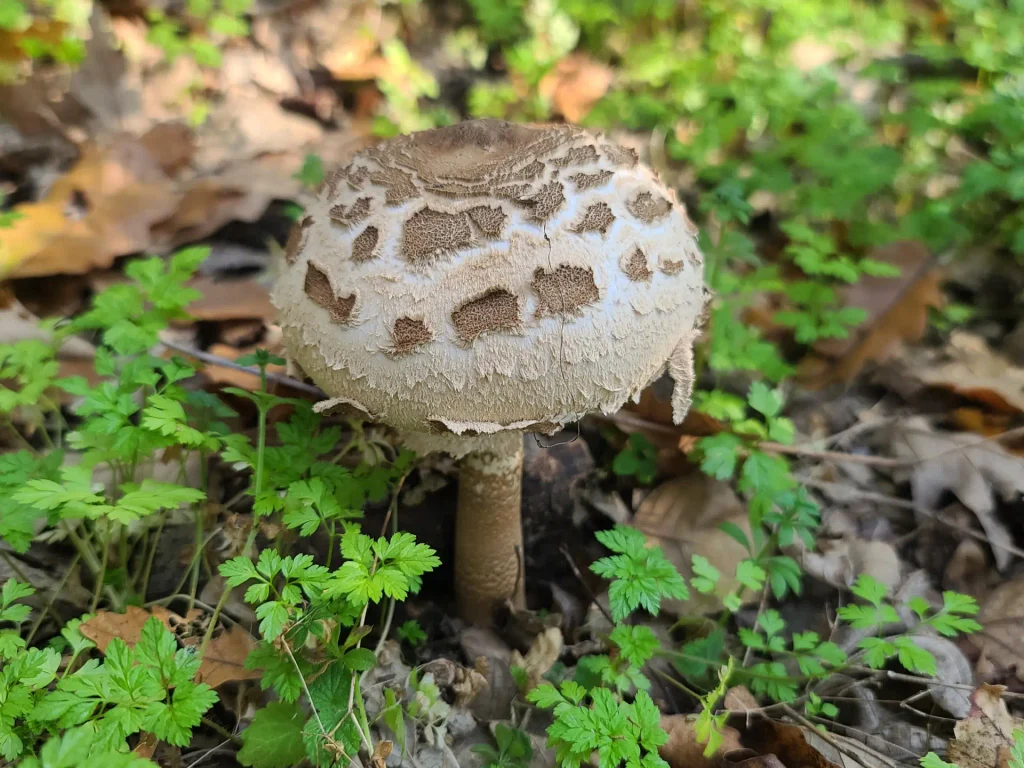
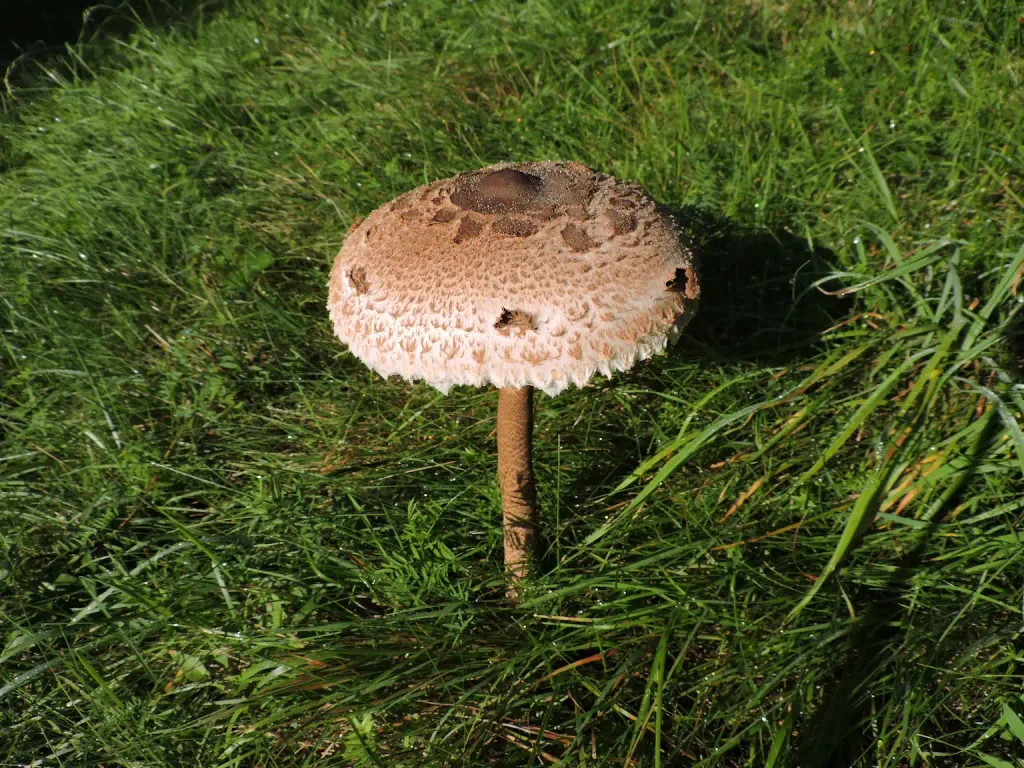
Cer was full of them. A full-grown parasol looks like an open umbrella: a tall, thin stem and a flat cap that can reach 25 centimeters across, the size of a dinner plate, with dark flakes on top and a smooth, dark bump in the middle. Below the ring, the stem is covered in scaly growths that look like snakeskin, and the ring itself comes loose as the mushroom grows, so you can slide it up and down. They grow in pastures and grassland, and sometimes in woodland.
My wife’s grandfather taught me this one on a walk near their village. He showed me what to look at on a parasol, and his rule was short: if it looks like that, pick it up, and if it doesn’t, walk away. The ones we picked together went on the fire with salt and pepper, only once he’d said they were good, and the taste was phenomenal.
The look-alikes are serious. Chlorophyllum molybdites, a toxic relative, has faintly green gills and no snakeskin on the stem, and some much smaller Lepiota species look like miniature parasols and are dangerous.
Porcini (Boletus edulis)
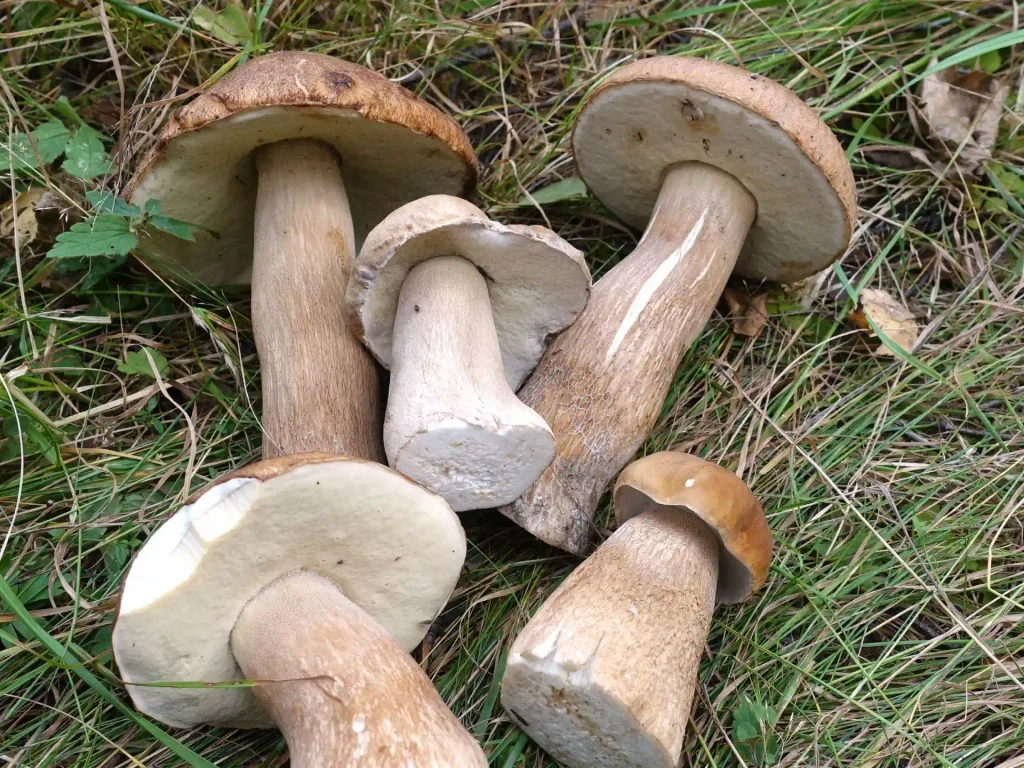
Porcini, also called the king bolete, have a stout stem that can grow 7 centimeters thick, about the width of a can of soda. The difference you see right away is underneath: porcini have tubes instead of gills, so the underside looks like a sponge of tiny holes. They live with trees, including pine, spruce and fir, and come up from summer to autumn.
The porcini in my freezer came from my wife’s grandparents. Sometime this spring or summer they called to say, just so you know, we’re drying porcini for you. They sliced and dried them in the village, and now they go into whatever I’m cooking when I want it to taste good, which is most of the time.
The look-alike is the bitter bolete, Tylopilus felleus, which isn’t toxic, but one of them can ruin the taste of a whole meal. Porcini have whitish pores and a pale net pattern on a brownish stem. The bitter bolete has pink pores and a dark net on a pale stem.
Chanterelle (Cantharellus cibarius)
The chanterelle is the mushroom I’ve found the most of. We were on the mountain above my wife’s grandparents’ village in Macedonia, the four of us on a walk, when we spotted a couple. Her grandparents are old, so they headed back to the house, and my wife and I kept going. We came back with two or three kilos, and they went into soup, into the oven with meat and into a pan with oil, salt and pepper.
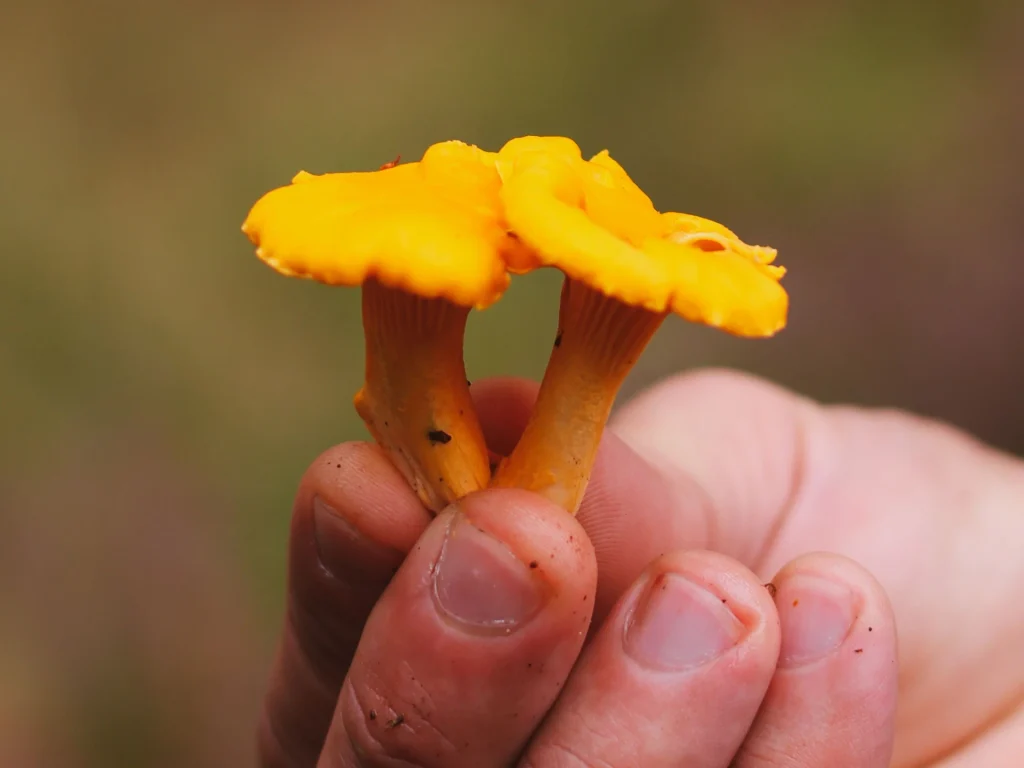
The chanterelle is yellow to dark yellow, with a cap that turns into a funnel as it grows. Instead of real gills it has blunt ridges that run down the stem, and a faint smell of apricots. It grows in both broadleaf and conifer forests.
The false chanterelle is a deeper orange, with real, forked gills instead of ridges, thinner flesh, a brown base to the stem and no apricot smell. The jack-o’-lantern mushroom is orange too and poisonous, and it has sharp, thin gills where the chanterelle has blunt ridges.
Oyster Mushroom (Pleurotus ostreatus)
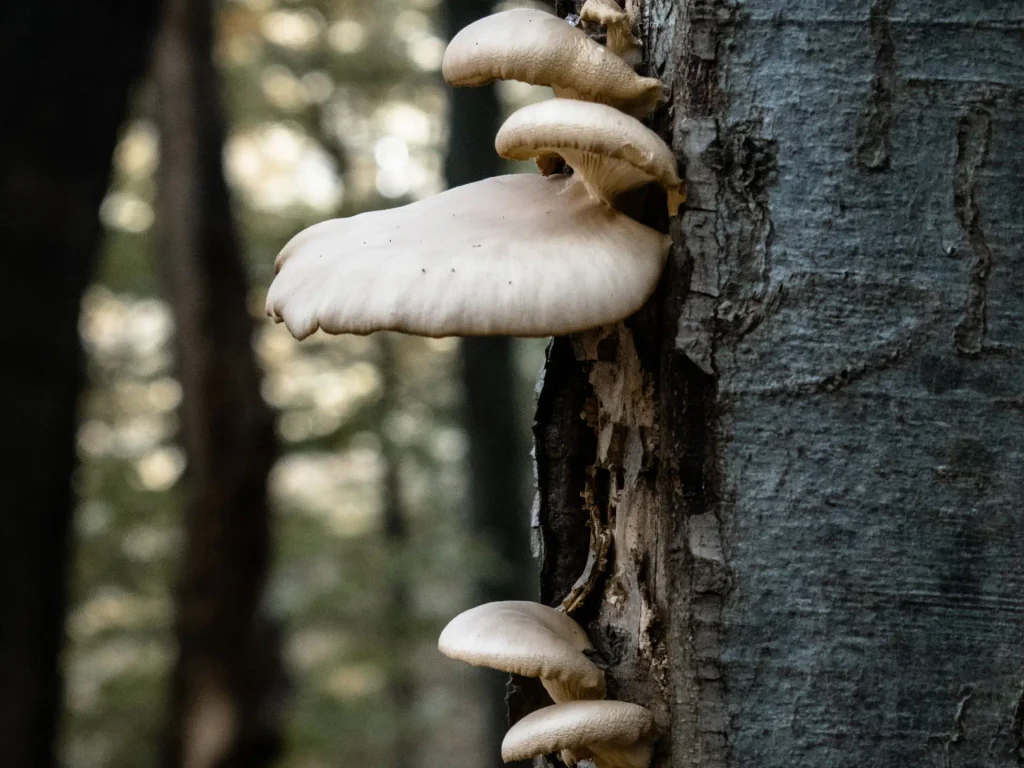
The oyster mushroom grows straight out of wood, in overlapping shelves shaped like a fan or an oyster shell, 2 to 30 centimeters across. It breaks down dying hardwood trees, beech in particular, and it’s grown commercially all over the world.
It’s one of my favorites. A friend of mine, a biology professor and trail runner I met through my wife’s college group, grew them as a business for a while. I went inside his shed once, exact temperature, humidity and light, and bags of wood chips with oysters growing out of them. My soup is thin-chopped garlic and onion, the oysters fried for a bit, then water, bouillon and whatever else I feel like that day. Those were farmed oysters, and so are the ones I buy at the store now.
In the wild, some wood-growing mushrooms look similar. Lentinellus species are toxic and are told apart by gills with jagged edges and a finely haired cap.
Common Puffball (Lycoperdon perlatum)
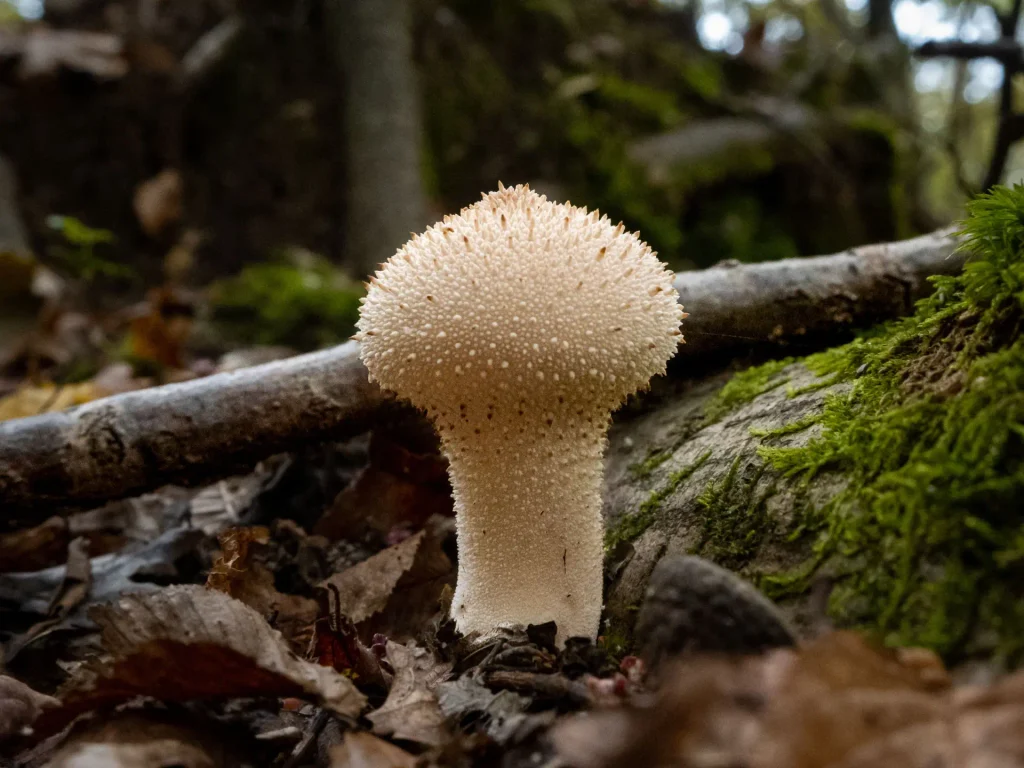
The common puffball has no cap and no gills. It’s a small, round ball, white when young, then grayish or brown, covered in short spines and little warts that rub off and leave pockmarks. It grows in fields, grassy clearings, along roads and in woods.
I’ve stepped on more of these than I can count. When a puffball is ripe the inside turns to powder, and pressing it, or even a raindrop landing on it, pushes out a little cloud of brown smoke, which is the spores. It’s one of the strangest things you’ll see in a forest. I’ve never eaten one, and I don’t have a single photo of one, because I never thought I’d one day have AFIELD.
The look-alike that matters is a young Amanita that hasn’t broken out of its sac yet, which can look like a smooth white ball. Cut in half from top to bottom, the young Amanita shows the outline of a mushroom forming inside, while a puffball is plain white all the way through. That’s how experts tell them apart, and I’d leave the knife work to them.
Fly Agaric (Amanita muscaria)
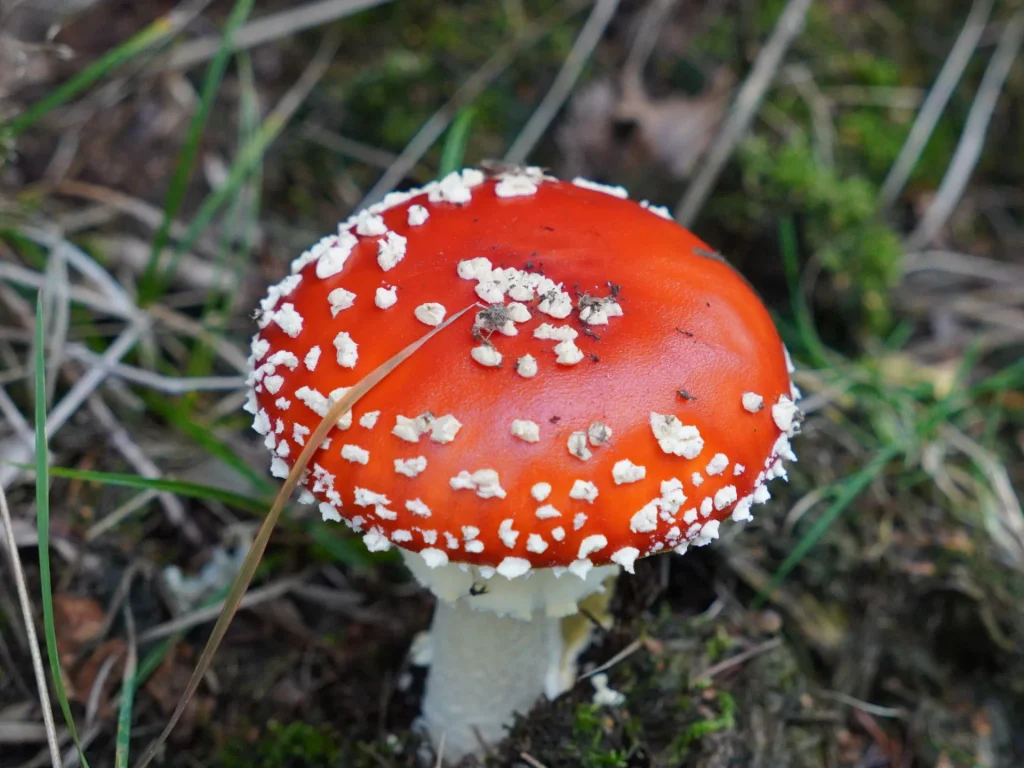
The fly agaric is the one everyone knows from cartoons, a bright red cap covered in white warts. It lives with trees, including birch, pine, spruce and oak, and it’s poisonous.
I think I’ve seen a couple, and I wasn’t sure, because they had hardly any white spots. Later I read that age and rain can fade the red and make the warts fall off, and heavy rain sometimes washes the spots away completely. The mushroom on every storybook cover doesn’t always look like its picture, which says a lot about identifying mushrooms from pictures.
Death Cap (Amanita phalloides)
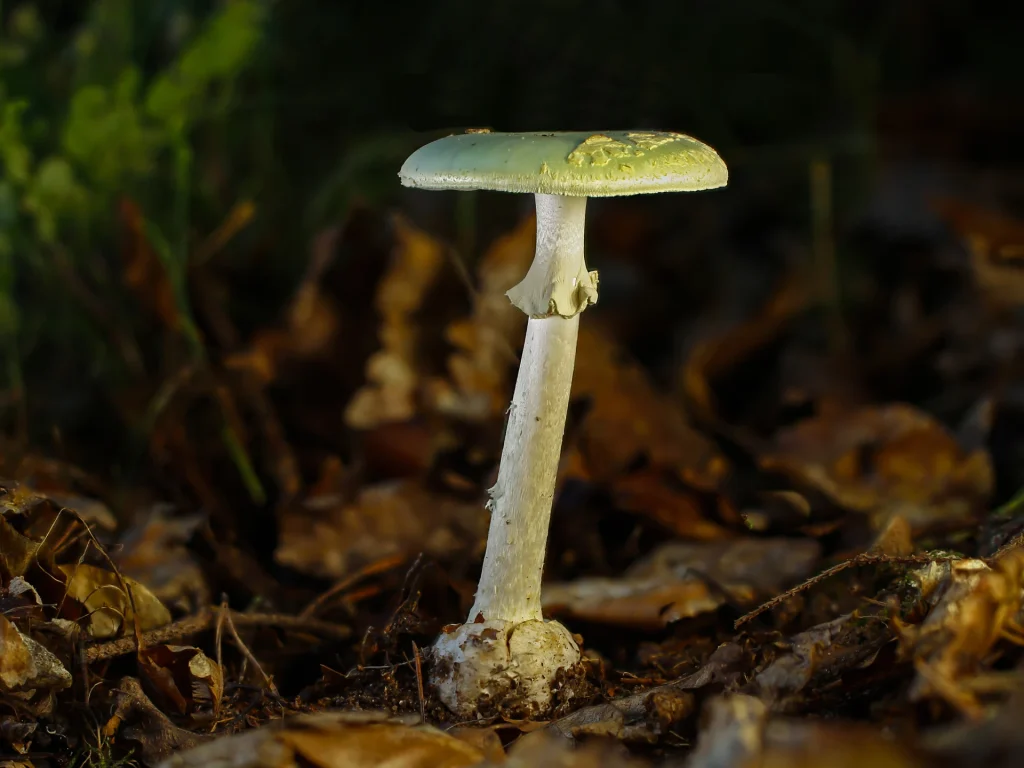
The death cap is deadly, and it’s the reason the cup at the base matters. Its cap is usually pale green, yellow-green or olive, but the color varies too much to trust, and there’s even a white form. The gills are white and crowded, there’s a floppy, skirt-like ring on the stem, and at the base there’s a white sac-like cup that’s often hidden under leaves. It most often lives with oaks, and also with beech, chestnut, birch and hornbeam, and it comes up in summer and autumn. Cooking doesn’t destroy its toxins.
It gets mistaken for several edible mushrooms: young field mushrooms whose caps still hide the gills, green-capped Russula species, which have no ring and no cup, Caesar’s mushroom, and puffballs when it’s young and still closed. I’ve never seen one myself. Cer is an oak mountain and oaks are the death cap’s favorite partner, so it could have been there, and I wouldn’t have known.
So How Do You Know?
I don’t, and that’s why I’ve never eaten a wild mushroom I identified myself. What I know comes from my wife’s grandparents. They aren’t mine by blood, but I’ve stayed with them, and they feel like my own. They live in Skopje and have a house in a village in Macedonia with a mountain above it, where picking mushrooms is a tradition and a trade, when the mushrooms come up, people pick them and take them to the city to sell. That’s how her grandparents learned.
Her grandfather also studied pharmacy and knows herbs, teas and natural remedies better than anyone I’ve met. He gave us his books, really old ones.
At the village we just go for walks. There might be chestnuts, quince, apples, herbs for tea, mushrooms, and he points things out. That’s how I learn, by watching someone who knows. The herbs we pick together get dried and then stored in paper bags so they don’t go moldy: wild thyme, chamomile, nettle, St John’s wort, yarrow.
With mushrooms, they don’t think about it. They’ve picked for so long that one look is enough, and it either is or it isn’t. If they have to think about it, it goes in the bin. A couple of times I brought them mushrooms I’d found, and those went in the bin too. I’ve never been sure about a mushroom myself, so there’s no negotiation. My wife is my other guide, she’s a molecular biologist, and between her studies and her grandparents she knows most of the Latin names and how to spot them.
That’s the line this whole post sits on. An article, an app or a photo can help you put a name on what you’re looking at, and that part is great fun. None of them can decide whether you eat it. The CDC’s advice is the same as my wife’s grandparents’: a trained expert checks it first, and if you don’t have one, you don’t eat it.
Back on the Hike
What I’ll remember most from those two weekends is the group, ten people and a different conversation with every one of them. It felt like the group bike tours I used to do, where you talk to everybody and find something in common with people you just met, and it’s the easiest kind of weekend adventure to plan, a chat group, a few cars, a mountain. Somewhere in the middle of it there’s always me, a few steps behind, looking at the ground. I can name a handful of common wild mushrooms now, but I still don’t know most of what I see down there, and I’ll keep walking and looking anyway.
Frequently Asked Questions
Why do mushrooms come up after rain?
The fungus lives underground or in wood and only puts up mushrooms when conditions are right. A 30-year survey of a Japanese oak forest found that rainfall and temperature both increased fruiting in the fungi that partner with tree roots.
What is a mushroom, actually?
It’s the fruiting body of a fungus, the part that makes and releases spores, a bit like a fruit on a tree. The fungus itself is a web of thin threads in the soil or in wood.
What’s the difference between gills and a sponge under a mushroom?
Gills are thin blades under the cap, like the pages of a book. A sponge is a layer of tiny tubes ending in small holes, which is what porcini have.
Which mushroom looks like a death cap?
Several edible ones, including young field mushrooms, green-capped Russulas, Caesar’s mushroom and puffballs. The cup at the base is a key difference, and it’s often hidden under soil or leaves.
Can an app identify common wild mushrooms?
An app can suggest a name, which helps you learn what you’re looking at. It can’t tell you a mushroom is safe to eat. The CDC’s advice is that a trained mycologist checks any wild mushroom before anyone eats it.
Sources
- Draper, E. “Why Are My Trees Blowing Bubbles?” Buckeye Yard & Garden onLine, Ohio State University Extension. bygl.osu.edu
- “Cer (mountain).” Wikipedia. en.wikipedia.org
- Vo, K. T. et al. “Amanita phalloides Mushroom Poisonings, Northern California, December 2016.” MMWR 66(21), CDC, 2017. cdc.gov
- “Royal Botanic Garden seeks respect for world’s fungi.” Phys.org, September 2018. phys.org
- Sato, H., Morimoto, S. and Hattori, T. “A Thirty-Year Survey Reveals That Ecosystem Function of Fungi Predicts Phenology of Mushroom Fruiting.” PLoS ONE 7(11), 2012. PMC3507881
- Ivančević, B., Matavuly, M. and Karaman, M. “Fungi (mushrooms and lichens) in Serbian legislation.” Biologia Serbica 34(1-2), 2012. ojs.pmf.uns.ac.rs
- Background pages, Wikipedia: Mushroom, Spore, Mycelium, Mycorrhiza, Volva
- Species pages, Wikipedia: Macrolepiota procera, Boletus edulis, Tylopilus felleus, Cantharellus cibarius, Hygrophoropsis aurantiaca, Omphalotus olearius, Pleurotus ostreatus, Lycoperdon perlatum, Amanita muscaria, Amanita phalloides

Filip Petreski is the founder of AFIELD and a multi-sport outdoor athlete. A two-time national cross-country MTB champion, snowboard instructor, and former dirt bike rider, he writes about the people, gear, and culture worth paying attention to in the outdoor world.