
The tire went flat on lap two, right after the feed zone.
I was leading. We had five or six laps to go, and I was out front when it happened. The whole thing went soft in seconds, and I knew immediately what it meant, a full lap between me and the feed zone, no spare. Just a flat tire and a cross country mountain bike I’d have to push until I got back around.
I sat down on the side of the course. For a moment I thought seriously about not getting up.
At a Glance
Filip Petreski raced cross-country mountain bikes in Macedonia, winning the national championship twice, as a junior and then as a senior. In the race that clinched his junior title, he flatted on lap 2 while leading, ran an entire lap, dropped to fourth, changed the wheel, and finished first. He stopped racing the season after his second title. It was exactly what he’d set out to do.
Table of Contents
How You End Up in Front
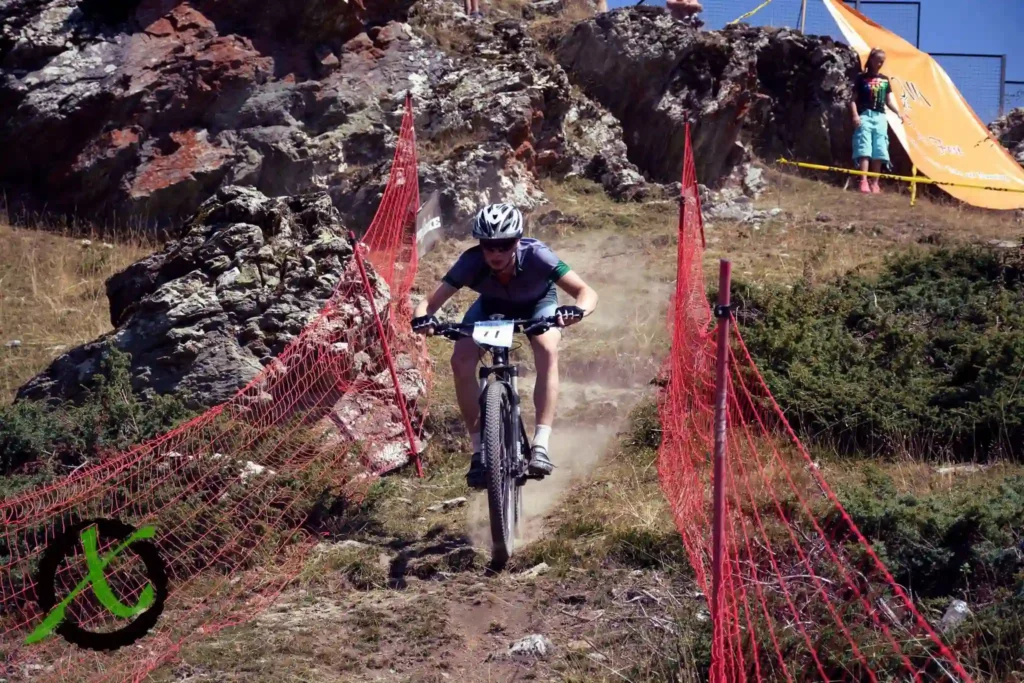
Macedonia is 85% mountains. Not hills. Mountains. Growing up there, riding off-road wasn’t a hobby I chose. It was just what the terrain was, and cross-country racing was the natural thing to do with it. XC is the full circuit, you climb, you descend, you handle whatever’s in between. Technical sections, steep drops, loose corners, and then back up again.
I never passed anyone on an uphill in my entire career. Every move I made came on the descents and the technical sections, where fitness matters less and reading the ground matters more. That was the racer I was.
The team was called Oxygen. Aleksandar Popovski ran it, and what he put into that team is the reason I got to race in any real sense. He took us to races in other countries, provided gear, coached, and believed in results before they showed up. I was a kid who loved riding his bike. He gave that a structure. I’m still grateful.
The bike was a hardtail for most of my career. My last race bike, given by the team, was a RAM XC One, full SRAM X9 2×10, 29er wheels, Maxxis Ikon tires, Avid brakes, RockShox fork, Shimano XT pedals. I still have it. I rode with friends doing downhill, a completely different discipline, and on technical terrain I could sometimes keep up with them on the hardtail. Sometimes I couldn’t.
There was one race in Croatia on a full suspension carbon frame where the linkage below the rear shock cracked during the race. I didn’t know until I went to pick up the bike afterward and the whole thing moved like rubber. Another centimeter and it would’ve broken mid-race. I got lucky that day.
The Lap I Had to Run
Six or seven laps. I was leading after the first one.
The flat hit right after the feed zone on lap two, the worst possible place. A full lap to cover before I could get back to the team for a wheel change. No way around it. I had to run.
I sat down on the trail bank first. The season had gone well, I was in front, and now I was looking at a DNF because of something with nothing to do with my fitness or my riding. The whole year in points was right there, about to disappear.
A race official came over and looked at me: “What are you doing? The season is really good. Don’t lose points because you DNF this race.”
I got up. I started running.
The lap felt long in a specific way that’s hard to describe. Every rider that came past me was a position lost, and I tracked each one. I went from first to fourth by the time I made it back to the feed zone. The team changed the wheel fast. I got back on the bike.
What happened after that is harder to explain precisely. Something had shifted. I wasn’t racing for position in the normal sense. I was chasing something back, and the technical sections and descents that I’d always used to make my moves opened up differently when I stopped thinking about the standings. I went through the field. One rider, then another. The crowd at the technical sections was loud. I don’t remember every detail, but I remember that noise.
I finished first.
That was the race that clinched the junior national championship. If I’d stayed sitting on that trail bank, I might not have been champion that year. The points were that close. It’s also the race I’d call perfect by any measure I can apply, the right power at the right moments, fitness that showed up exactly when it needed to, every decision landing correctly. All of it on a day I ran an entire lap in frustration.
Two Titles. Then I Stopped.
Before any of this, I’d set one goal.
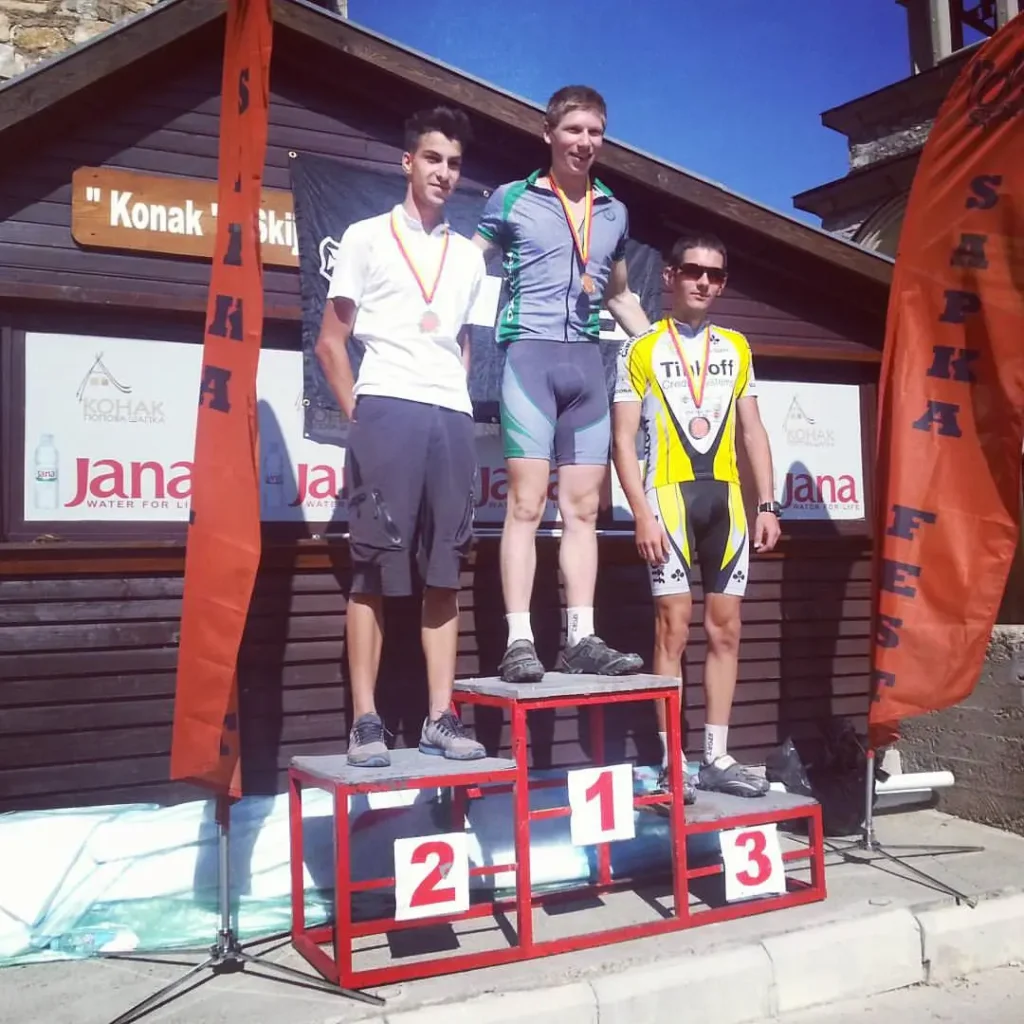
National champion as a junior, then as a senior, back to back. That was it. Not a UCI ranking, not racing abroad at a higher level. Two national titles on a hardtail in Macedonia. I knew what I was working toward, and I knew when it would be done.
The junior title came in the flat tire race season. The senior title came the year after. Both done. Goal complete.
People around me saw more potential and said so. They wanted me to keep going, build on the results, push further. I understood why. But I’d achieved exactly what I’d set out to achieve, and the drive that got me through running a lap on a flat tire was the drive to finish what I’d started, not the drive to find out what was next. I felt it clearly. It was done.
The hardest moment of my whole racing career wasn’t the Croatia race, or the flat in the championship. It was telling Aleksandar Popovski I wasn’t riding the next year. That was the season I’d just won the senior title. He’d put too much into me for anything less than an honest conversation. I had it. I stayed with the team, helping at feed zones, taking younger riders to races, passing on whatever I’d learned.
I think about people like Filip Derkoski, a friend I’ve known most of my life, who went on to represent Macedonia at the Olympics as a swimmer. Different sport, different water, same country and the same thing underneath, you find something you’re serious about and you take it as far as you set out to go.
The habit of moving and showing up didn’t go away. It just changed form. I’ve been going for a walk every day lately, no championship at the end. Same logic, smaller stakes. Still works.
Frequently Asked Questions About Cross Country Mountain Bike Racing
How do cross-country mountain bike races work?
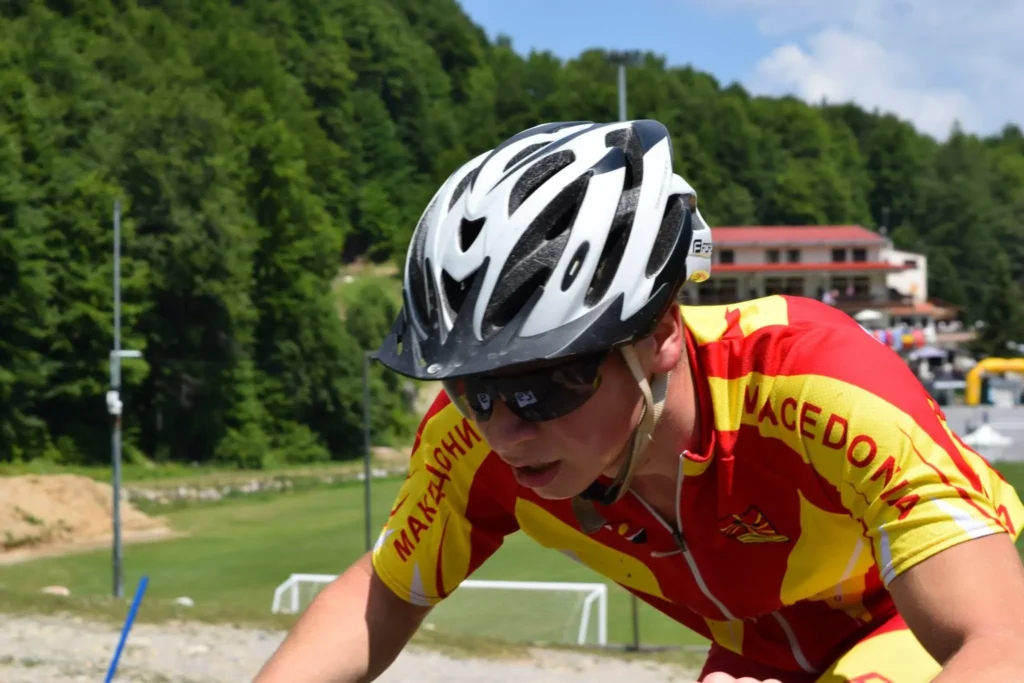
XC races are multi-lap circuits on mixed terrain, climbs, technical sections, and descents, all in one continuous effort. Riders complete a set number of laps, typically four to seven depending on the level, with feed zones at designated points each lap where team members can hand off water bottles or make a wheel change. The UCI XCO (Cross-Country Olympic) format is the international and Olympic standard, and has been part of the Olympic programme since Atlanta 1996. Elite races last roughly one to one and a half hours. One race, one result. No segments.
What is the difference between XC and downhill mountain biking?
XC is a complete effort under your own power, you climb every hill, descend every drop, and complete the full circuit repeatedly under race conditions. Downhill mountain biking is gravity racing, one timed run from top to bottom, with a vehicle or lift back to the start. XC demands fitness across the whole range, sustained climbing, technical handling, repeated efforts over an hour or more. Downhill demands technical skill and nerve on a single descent. Many XC riders do climbing mountains and exploring terrain on foot off the bike too. The fitness carries over.
The Bike Is Still Here
The RAM XC One the team gave me, SRAM X9, 29er, Maxxis Ikons, RockShox fork. Hardtail. Two national championships on that bike. Races in other countries I wouldn’t have gone to without Aleksandar and Oxygen getting me there.
I don’t race it now. I do other things, climbing, riding bikes through cities I don’t know yet, moving through terrain that doesn’t have a timing chip at the end. The drive is the same. The format keeps changing.
The bike stays. It’s not a trophy. It’s just the bike I rode when I was doing exactly what I’d set out to do, and it held up for all of it.
That’s enough to keep it around.
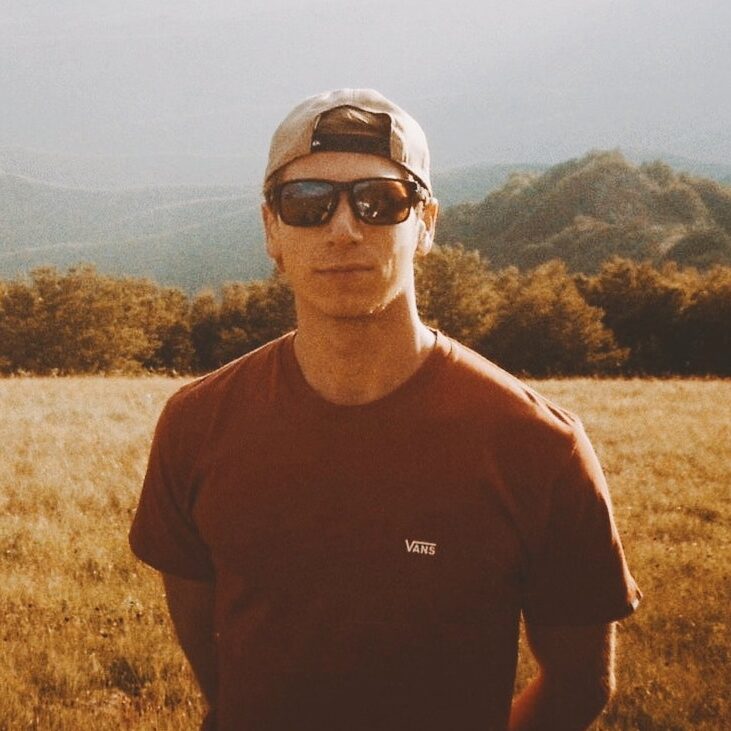
Filip Petreski is the founder of AFIELD and a multi-sport outdoor athlete. A two-time national cross-country MTB champion, snowboard instructor, and former dirt bike rider, he writes about the people, gear, and culture worth paying attention to in the outdoor world.