
Nobody had to convince you to climb a tree as a kid. You just did it. You reached for a branch, pulled yourself up, figured out the next one, and kept going until someone called you down for dinner. The benefits of climbing trees weren’t a concept you understood. They were something you felt.
I climbed trees long before I ever stood on a slackline. The instinct was the same, find something unstable, make your body figure it out. What I didn’t know then was that those two activities were training the exact same neural system.
A 2015 study published in Perceptual and Motor Skills found that adults who spent two hours doing dynamic proprioceptive activity, including tree climbing, improved working memory by around 50% (Alloway, R.G. & Alloway, T.P., Perceptual and Motor Skills, 2015). That’s not a minor cognitive bump. That’s a meaningful, measurable shift.
Here’s what the research actually shows, and how to use it.
At a Glance
Adults doing dynamic proprioceptive activity (tree climbing, balance beams) improved working memory by ~50% after 2 hours. Yoga and classroom controls: 0% improvement. (Alloway & Alloway, Perceptual and Motor Skills, 2015)
Every 5kg drop in grip strength is associated with a 16% rise in all-cause mortality, a stronger predictor than blood pressure. (PURE study, The Lancet, 2015)
Tree climbing produces 195 injuries per 100,000 participants. Soccer produces 4,296. That’s 22 times the rate. (Beaulieu & Beno, Paediatrics & Child Health, 2024)
Proprioceptive training across 19 studies and 621 athletes significantly improves balance, stability, and injury resilience. (Yılmaz et al., BMC Sports Science, 2024)
What Did the Tree Climbing Study Actually Find?
The Alloway & Alloway 2015 study is the one study most cited in coverage of tree climbing benefits, and it deserves a careful read. Adults who completed two hours of dynamic proprioceptive activity, specifically including tree climbing and balance beams on irregular terrain, improved working memory scores by approximately 50% (Alloway, R.G. & Alloway, T.P., Perceptual and Motor Skills, 2015). That improvement showed up in the same session.
Working memory is the system your brain uses to hold and manipulate information in real time. It’s not the same as long-term memory. Think of it as your mental RAM, the capacity that determines how well you follow instructions, process new information, and make decisions under pressure.
The study didn’t just measure tree climbers in isolation. It ran a controlled comparison. Participants doing yoga, and a separate group in a classroom lecture, showed zero working memory improvement under the same conditions. The effect was specific to the dynamic, physically demanding movement.
That specificity is the part worth sitting with. Not all movement does this. Not all outdoor activity does this. The proprioceptive demand, specifically the requirement to constantly sense and adjust your body’s position in three-dimensional, unpredictable space, appears to be the mechanism that triggers the cognitive uplift.
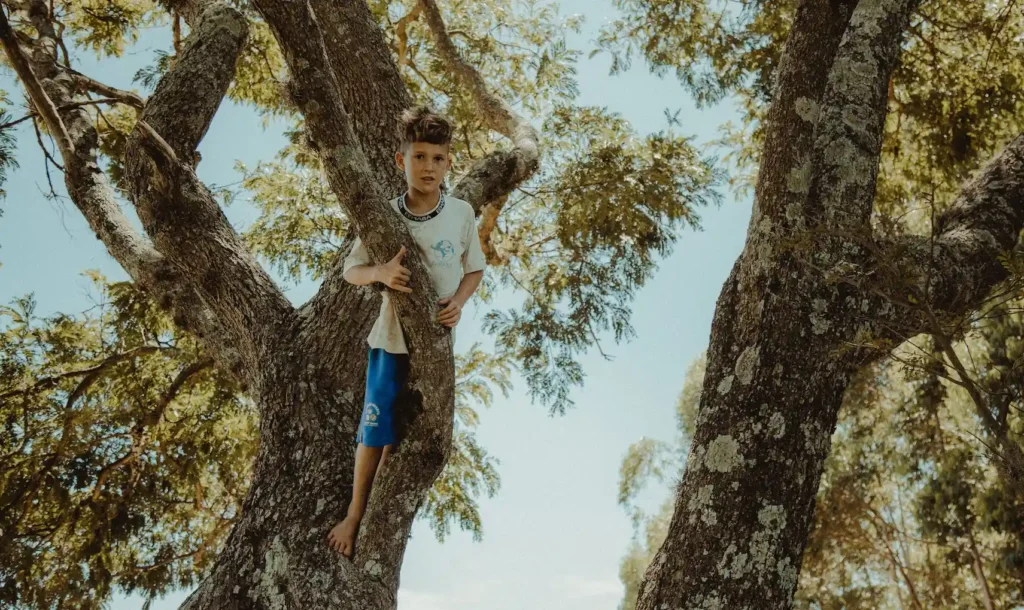
Why Yoga Didn’t Do the Same Thing
The difference comes down to static versus dynamic proprioception. Yoga demands significant body awareness, balance, and controlled movement. It’s not passive. But yoga poses are largely predictable, repeatable positions that you hold or transition through in a known sequence. Your proprioceptive system is engaged, but it’s not being continuously surprised.
Tree climbing is the opposite. Every branch has a different diameter, texture, angle, and flex. Your hands, feet, and core are making micro-corrections several times per second in response to inputs that haven’t been pre-programmed. That continuous novelty is what appears to drive the working memory response. The brain doesn’t just move the body through space. It builds a real-time map of that space and updates it constantly.
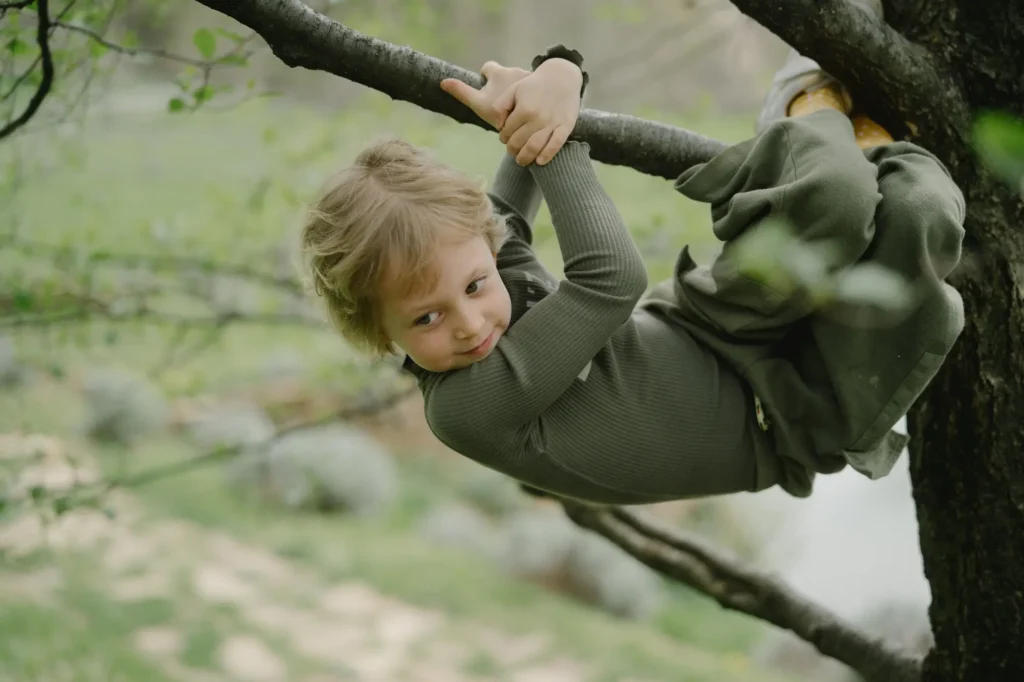
Why Proprioception Is the Mechanism That Matters
Proprioception is your body’s internal positioning system. It’s the sense that tells your brain where your limbs are without looking. A 2024 systematic review in BMC Sports Science, Medicine and Rehabilitation, covering 19 studies and 621 athletes, found that proprioceptive training significantly improves balance, stability, and injury resilience (Yılmaz et al., BMC Sports Science, 2024). That finding holds across age groups and activity types.
The distinction between static and dynamic proprioception matters here. Static proprioceptive work, holding a balance pose, standing on one leg, is valuable. Dynamic proprioceptive work, moving through continuously changing, unpredictable terrain, appears to produce a stronger cognitive-motor training effect. The brain doesn’t just need to know where you are. It needs to predict where you’ll be in 0.3 seconds, then correct in real time.
A 2022 meta-analysis in Applied Psychology, Health and Well-Being also found that outdoor physical activity produces greater psychological wellbeing benefits than the same exercise done indoors, including reductions in anxiety, fatigue, and improvements in positive mood (Wicks et al., Applied Psychology: Health and Well-Being, 2022). The environment itself contributes to the effect, not just the movement.
Modern gym equipment is largely designed to optimise movement in straight lines, a barbell goes up and down, a cable machine pulls in one direction, a treadmill moves forward at a fixed grade. That’s not a criticism of gyms. But the human body evolved across hundreds of thousands of years on irregular terrain, with variable surfaces underfoot and overhead. Trees are, in a literal sense, closer to the environment our nervous system was built for and a good reason to plan your outdoor movement day around them.
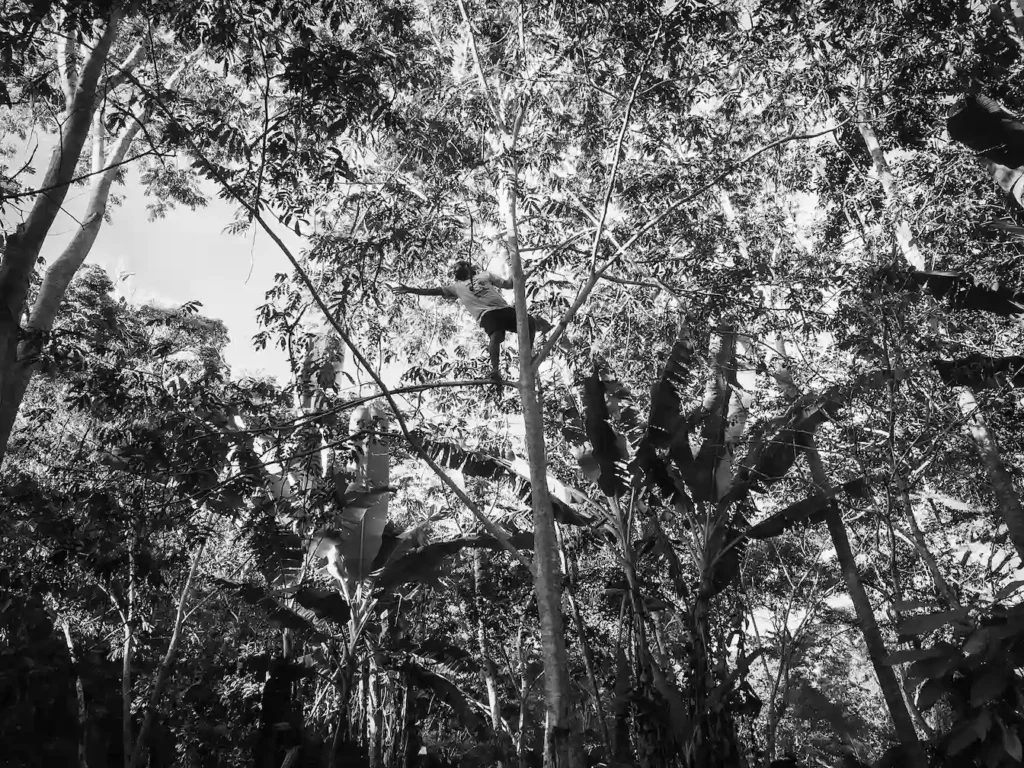
What Muscles Does Tree Climbing Actually Work?
Tree climbing is a compound movement that doesn’t isolate a single muscle group. A single branch pull engages your forearms (grip and wrist flexors), latissimus dorsi, biceps, rear deltoids, and core stabilisers all at once. Your legs contribute through friction climbing and branch-standing, loading the quads, calves, and hip flexors depending on the tree’s geometry.
What makes it distinct from fixed gym equipment is the variability. A pull-up bar is always the same diameter, always at the same angle, always in the same plane of motion. A tree branch changes angle as you move along it. The bark texture shifts. The flex under your weight is never identical twice. That variability recruits stabiliser muscles that standard equipment rarely reaches.
There’s also a coordination demand that’s harder to replicate indoors. Your body has to sequence grip, pull, push, and transfer weight simultaneously while reading the structure in front of you. That’s not a strength circuit. It’s more like a full-body puzzle with a time constraint.
Why Grip Strength Is the Signal Worth Watching
Grip strength emerges naturally from tree climbing, but it’s worth treating as its own training variable. Not because a strong handshake is useful (it is), but because the research on grip as a health marker is striking enough that it changes how you think about upper-body training priorities entirely.
What Does Grip Strength Have to Do With Living Longer?
The PURE study, published in The Lancet in 2015, tracked 139,691 people across 17 countries and found that every 5kg reduction in grip strength was associated with a 16% increase in all-cause mortality, a 17% increase in cardiovascular death, a 7% increase in heart attack risk, and a 9% increase in stroke risk (Leong, D.P. et al., PURE study, The Lancet, 2015). Grip strength was a stronger mortality predictor than systolic blood pressure.
That finding should stop you. Grip strength predicting mortality better than blood pressure is not what most people expect. The researchers weren’t claiming grip strength causes longevity. They were identifying it as a marker for overall muscular fitness, neuromuscular function, and general physical resilience. Low grip strength is a signal that other systems are declining.
Standard grip training (barbells, deadlifts, farmer carries) builds grip through a fixed range of motion on a smooth, uniform surface. Tree bark is rough, irregular, and angled differently every time you grab it. The forearm has to generate force through variable wrist positions, which recruits the intrinsic hand muscles and wrist stabilisers more comprehensively than any standard implement. I’m not claiming trees replace a barbell programme. But they build grip qualities that barbells don’t.
To be direct, climbing trees doesn’t cure heart disease. It doesn’t override genetics, diet, or sleep. What it does is build the grip and muscular fitness that the PURE study identified as predictive of better outcomes. That’s a meaningful and honest case for including it in your movement practice.
Is Tree Climbing Actually Dangerous for Adults?
The numbers here are more surprising than most people expect. CHIRPP data analysed via PMC (2024) puts recreational tree climbing at 195 injuries per 100,000 participants. For context, playground equipment sits at 4,090 per 100,000, and soccer produces 4,296 per 100,000 (Beaulieu & Beno, Paediatrics & Child Health, 2024). Tree climbing carries more than 22 times fewer injuries per participant than soccer.
That doesn’t mean tree climbing is risk-free. It scales directly with height. A fall from 4 metres is substantially more dangerous than a fall from 1.5 metres. But height is a variable you control. The risk profile at low branches is genuinely modest.
The social barrier is real, though. Adults feel conspicuous climbing trees in public parks. That’s not a physical risk. It’s a cultural one. And it’s worth naming, because it’s probably the bigger obstacle for most people reading this.
To put the numbers plainly, a recreational soccer player is statistically more than 22 times more likely to get injured than someone climbing trees at a sensible height. If you’re playing five-a-side on weekends without giving it a second thought, the risk calculus on a tree at 2m doesn’t hold up as a serious objection.
Why Does Slacklining Activate the Same Brain System?
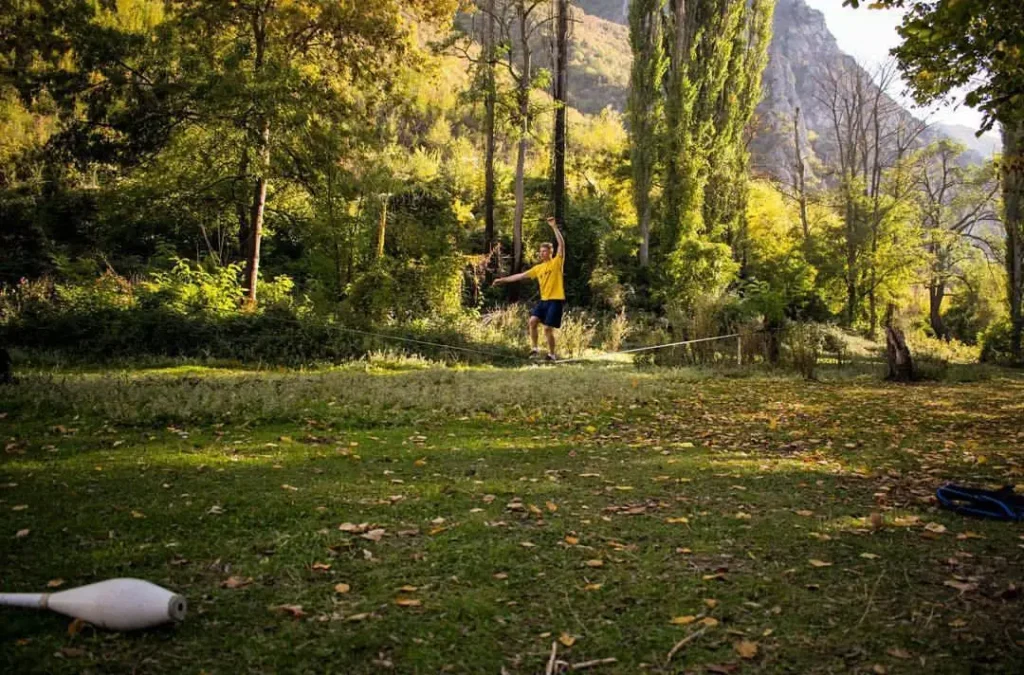
Slacklining produces measurable cognitive-motor brain changes during activity. A 2024 EEG study published in Frontiers in Human Neuroscience recorded these changes in real time, finding that the balance demands of slacklining produce significant cognitive-motor interference effects on auditory attention processing (Papin et al., Frontiers in Human Neuroscience, 2024). That’s the same proprioceptive system that tree climbing fires up.
I came to slacklining after years of climbing trees and bouldering. The transition felt natural in a way I couldn’t explain at the time. Now I understand it better, both activities demand continuous postural recalibration in response to an unstable surface. The nervous system doesn’t distinguish between a flexing branch and a flexing line. It just solves the problem.
The cross-training case for combining the two is strong. Trees load the upper body and proprioceptive system through three-dimensional grip and positioning. Slacklining loads the lower body and core through lateral instability. They complement each other without duplicating the same stimulus. Alternate between them across a week and you’re training the proprioceptive system from two different angles.
If you want a thorough breakdown of slacklining’s health benefits, Dr. Chris Raynor covers the orthopedic side well:
If you want to take it further, the AFIELD slacklining guide covers everything you need to get started.
How to Actually Do This as an Adult
Most parks have accessible branches at 1.5 to 3 metres. The barrier isn’t access, it’s social permission. Adults feel like they need a reason. You don’t. The Alloway study used adult participants in a research protocol, which is as much permission as you need if peer review helps (Alloway, R.G. & Alloway, T.P., Perceptual and Motor Skills, 2015).
A few practical notes before you go:
Height: Start at 1.5 to 2 metres. That height delivers the full proprioceptive and strength stimulus with a manageable fall consequence. The research doesn’t require altitude.
Tree selection: Look for branches at least 1.5 times the diameter of your wrist, with no visible cracks or bark peeling that suggests rot. Oak, beech, and ash are structurally reliable. Avoid anything that creaks under lateral pressure.
Footwear: Flat-soled shoes with thin rubber give more proprioceptive feedback than thick cushioned soles. Barefoot on lower branches works too. That sensory feedback loop is part of the benefit.
Trees have been available as fitness equipment for longer than any gym subscription has existed. They’re free, they’re everywhere, and they predate every fitness trend by about 300,000 years. You don’t need much of a plan, just a park, the willingness to look slightly unusual for five minutes, and maybe an idea of how to build the rest of your outdoor movement day around it.
Does climbing trees actually improve memory?
Yes. Adults who did two hours of dynamic proprioceptive activity, including tree climbing, improved working memory by approximately 50%, according to a 2015 study in Perceptual and Motor Skills by Alloway and Alloway. Yoga and classroom controls showed zero improvement in the same timeframe. The effect was specific to dynamic, unpredictable movement.
What muscles does tree climbing work?
Tree climbing is a full-body compound movement. It primarily loads the forearms, latissimus dorsi, biceps, and core stabilisers. Unlike fixed gym equipment, trees demand micro-adjustments from stabiliser muscles throughout the entire climb. The variability of bark, branch diameter, and angle recruits muscles that standard pulling exercises rarely reach.
Is tree climbing good exercise for adults?
It’s one of the more complete forms of outdoor exercise available. It combines cardiovascular output, full-body strength, proprioceptive challenge, and real-time problem-solving. A 2022 meta-analysis (Wicks et al., Applied Psychology: Health and Well-Being) found outdoor physical activity produces greater psychological wellbeing benefits than the same exercise done indoors. Age is not a contraindication.
How does tree climbing relate to slacklining?
Both activities train the same proprioceptive system: the body’s ability to sense and adjust position in real time. A 2024 EEG study in Frontiers in Human Neuroscience confirmed measurable cognitive-motor brain changes during slacklining. The two activities cross-train each other well. Trees load the upper body; slacklining loads the lower body and core.
Is tree climbing dangerous for adults?
Considerably less dangerous than most common sports. CHIRPP data (Beaulieu & Beno, 2024) puts tree climbing at 195 injuries per 100,000 participants. Soccer sits at 4,296, more than 22 times the rate. Risk scales with height. Starting at 1.5 to 2 metres keeps the fall consequence manageable while preserving the full training benefit.
What is proprioception and why does it matter?
Proprioception is your body’s internal sense of position, balance, and movement, the system that tells your brain where your limbs are without looking. A 2024 systematic review in BMC Sports Science (Yılmaz et al., 19 studies, 621 athletes) found proprioceptive training significantly improves balance, stability, and injury resilience across age groups and activity types.
Can you build grip strength from tree climbing?
Yes, and the health stakes are higher than most people realise. The PURE study (The Lancet, 2015, n=139,691 across 17 countries) found every 5kg reduction in grip strength was associated with a 16% rise in all-cause mortality. Trees build grip through variable bark textures and angles that barbells can’t replicate, recruiting the intrinsic hand muscles more comprehensively.
What age can you start climbing trees again?
There’s no upper age limit backed by evidence. The Alloway study used adult participants. Start low, choose sturdy branches at least 1.5 times your wrist diameter, and wear flat-soled grippy footwear. Most parks have accessible low branches at 1.5 to 2 metres, enough height for the full proprioceptive and grip benefit with minimal fall risk.
Why the Benefits of Climbing Trees Add Up
I climbed trees before I knew any of this. The instinct was right, and it turned out the science agreed. A 50% working memory boost, grip strength tied to longevity markers, an injury rate 22 times lower than soccer. The benefits of climbing trees aren’t niche or speculative. They’re measurable, replicated, and available for free in any park.
Proprioception is trainable. It’s also one of the more neglected training variables in most adult fitness routines. Trees address it directly, without equipment, without a subscription, and without programming. The nervous system doesn’t require a gym. It requires novelty, irregular surfaces, and the occasional need to figure out where the next branch is.
If you want to extend the work, slacklining is the natural next step. It hits the same system from a different angle, and the two activities build on each other in a way that structured gym training rarely does.
If you want to extend the work, slacklining is the natural next step. It hits the same system from a different angle, and the two activities build on each other in a way that structured gym training rarely does. Or start broader and plan your full outdoor movement day around both.

Filip Petreski is the founder of AFIELD and a multi-sport outdoor athlete. A two-time national cross-country MTB champion, snowboard instructor, and former dirt bike rider, he writes about the people, gear, and culture worth paying attention to in the outdoor world.