
At a UCI Downhill World Cup in Pal Arinsal, Andorra, Amaury Pierron went down hard in the final section of his race run. The mountain bike airbag under his jersey fired in the milliseconds before he hit the ground. He got up, got back on the bike, and kept going. I saw the clip on Instagram yesterday. It wasn’t posted about the airbag. Just another highlight from a race day, the kind that fills your feed during World Cup season. The airbag was doing its job in the background while everyone was watching the crash.
I’ve ridden long enough to know what a fall like that normally costs you.
At a Glance
- Airbag protection vests are already being worn in World Cup downhill racing
- Alpinestars and Dainese are both developing dedicated MTB systems
- The UCI has a working group with a target of submitting a first regulatory proposal by January 2027
What Happened in Skiing First
In November 2024, FIS made airbags mandatory for all Downhill and Super-G ski athletes: World Cup and European Cup, men and women both. The mandate came after Matilde Lorenzi, a 19-year-old Italian alpine skier and national super-G champion, crashed during training at Val Senales, Italy, on October 28, 2024 (Wikipedia, 2024). She was 19. She died that night.
The technology already existed. Dainese’s D-air system, a vest that inflates automatically on crash detection, had been used in skiing and motorsport for years (Dainese). What it took was a mandate to make it standard. FIS now requires airbags for every speed discipline athlete, with exceptions only where the system physically restricts safe movement for a specific rider (FIS, 2024).
MTB doesn’t have that mandate yet.
How the Technology Works
The system most people are talking about for MTB is the Alpinestars Tech-Air MX. Three accelerometers and three gyroscopes track what your body is doing in real time, and when the system detects a crash it deploys in about 40 milliseconds (Alpinestars, 2024). Shoulders, chest, and back. Over four times the impact protection of standard passive armor when deployed. It retails at $699.95, runs on a 30-hour battery, and it wears as a mountain bike airbag vest under the jersey, flat until it fires. Built for motocross first, launched at MXGP Flanders in July 2024 (MXGP, 2024).
Dainese has been developing a DH-specific system in parallel and has already tested it at World Cup races. It’s still not available to consumers.
I rode my dirt bike without body armor. I know it’s good to have, but I tried a full torso protector once, not just the vest, and it felt restrictive. I don’t think foam pads on your elbows will stop a broken arm anyway. They prevent scratches, and that’s about it. The vest format is different. I guess you don’t feel it until you need it, and hopefully you never do. That’s what makes the calculation different. I’d actually want to try one.
The Riders Who Are Already Using It
“The air bag saved me big time on the last crash yesterday so I’m really thankful for that and pretty much I walked out of it, a little bit bruised, but it could be way way worse, so we good.”
Loic Bruni – speaking to Pinkbike at the Loudenvielle World Cup, May 2026
Pierron’s crash at Pal Arinsal is a second example from this season alone. The brand of his airbag hasn’t been officially confirmed, but the vest fired, and he walked away.
Fabien Barel, three-time UCI Downhill World Champion and Canyon Factory Racing Team manager, has been working with Dainese on a DH-specific system for over three years. He had a serious crash last October without one. As he told Pinkbike: “I had a really heavy crash last October. Unfortunately, I didn’t have it and it cost me a lot. It cost me a good 5 to 6 months of my life and quite some consequences and a close call.” He calls the technology a “no brainer.”
The reason it matters in downhill and not in cross country comes down to speed and terrain. When I was racing XC I wore glasses and a helmet. That’s appropriate for that format, you’re on mixed terrain, climbing and descending, and even on the fast sections you’re not holding that speed long. Downhill is another sport. Those riders are hitting speeds you’d expect on a motocross track, but the course has roots, rocks, jumps, and gaps all packed in together. A motocross track is predictable. A DH course isn’t. DH riders are a different breed, and I mean that seriously.
The airbag also does something beyond keeping riders safe in the moment. It lets them push harder because the safety net is there. Faster times, more progression, longer careers.
What the UCI Is Working On
The UCI is moving toward a regulatory framework. Pinkbike obtained an internal UCI document outlining a working timeline (Pinkbike, 2026): subgroups delivering preliminary work by end of August, plenary meetings through September, a global stakeholder meeting in October or November, a first draft of the regulatory framework in November, and a proposal to the UCI Management Committee by the end of January 2027. Only the UCI Management Committee can approve new regulations.
Barel told Pinkbike his expectation is that multiple companies will have a DH-specific algorithm ready by this winter. His own team will make airbags mandatory for Canyon Factory Racing riders in 2027.
The precedent from other sports is worth noting. The FIM mandated airbags in MotoGP in 2018. Eight years later, motorcycle airbag jackets sell for under £300, as prices dropped with scale. MTB is at the beginning of that same curve.
I saw a comment on of the posts from someone who said their wife wears an airbag vest when she rides horses. Same technology, completely different sport. It goes wherever people move fast through terrain that doesn’t forgive mistakes, and we probably haven’t thought of all the places that covers yet.
A lot of riders got hurt on downhill courses before anyone started taking this seriously. The technology has been in motocross and skiing for years. MTB is catching up now, and from what I can see, it isn’t waiting for something to go wrong first to make it happen.
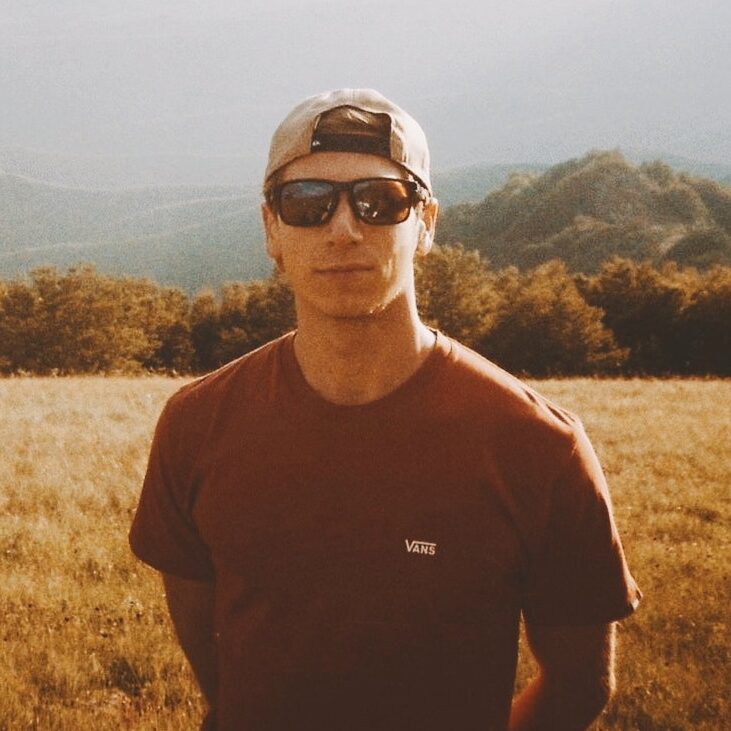
Filip Petreski is the founder of AFIELD and a multi-sport outdoor athlete. A two-time national cross-country MTB champion, snowboard instructor, and former dirt bike rider, he writes about the people, gear, and culture worth paying attention to in the outdoor world.