
It started with a video online. I saw someone walking a slackline and immediately wanted one. An old friend bought me a Gibbon slackline as a present. Then someone broke into my car and stole my backpack from the trunk, slackline inside. Gone.
A few months later, a local fitness center that was importing Gibbon slacklines held an open event in the city park. Anyone could show up and try. I went. Turned out I was the only person there who could actually walk the line. That led to a collaboration, they gave me slacklines, I set them up in the park regularly, and people started showing up. That’s how a slacklining culture started in my city.
I was active with it from early 2017 through about three years of serious sessions, from walking a standard 15-meter (49 ft) beginner setup, to tying two 30-meter (98 ft) lines together and walking 60 meters (197 ft), to eventually getting into tricklining on the Gibbon Andy Lewis Trickline. I’ve competed as a 2x national mountain bike champion. I ride dirt bikes. I snowboard. I’ve tried a lot of things with my body. Slacklining did things none of those other sports quite managed.
Here’s what the benefits of slacklining actually look like.
At a glance
– Slacklining is classified as vigorous physical activity at 6.0 MET, meeting WHO exercise recommendations in a single session (PMC9029838, 2022)
– Core strength is the biggest noticeable gain, the kind of deep stabilization work that gym exercises don’t reach
– Legs respond strongly too, mine got bigger from slacklining than from years of competitive MTB racing
– Balance improvements are measurable and dramatic, a 5-day training program produced a 333% improvement in static balance (PMC9029838, 2022)
– The cognitive and mental focus benefits are real, backed by EEG studies and it’s the closest thing to meditation I’ve found outdoors
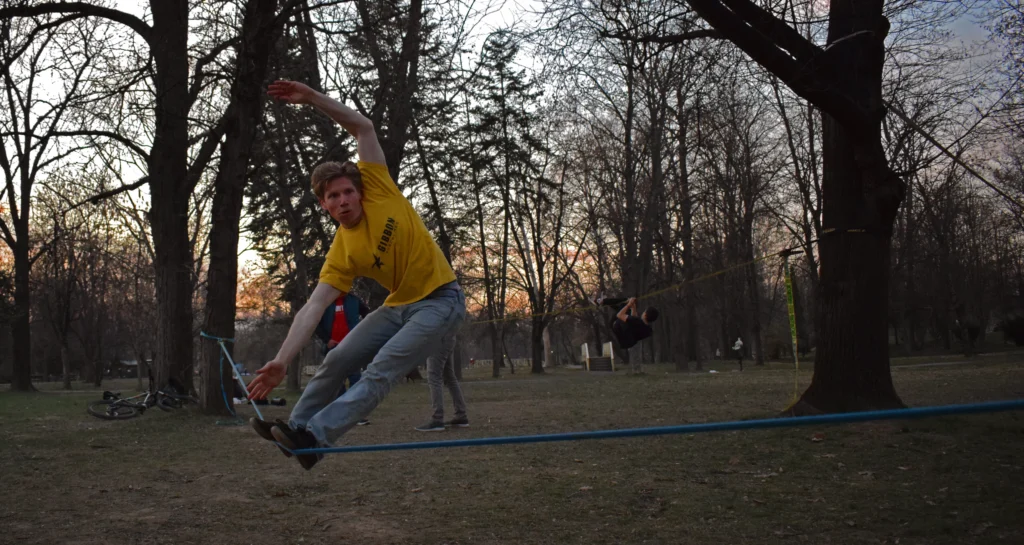
What Is Your Body Actually Doing on a Slackline?
Most people think slacklining is a balance trick. It isn’t. It’s a full-body coordination problem that never stops moving. A 5-day slackline training program produced a 333% improvement in static balance on foam surfaces (eyes open), and researchers classified slacklining as vigorous physical activity at 6.0 MET, enough to meet WHO weekly exercise recommendations in a single session (PMC9029838, 2022).
The reason is constant micro-adjustment. The line moves. Every fraction of a second, your body is detecting the shift and responding, feet, ankles, knees, hips, core, arms, neck. All of it, continuously. It’s not like standing on a BOSU ball, which has a fixed wobble pattern you eventually memorize. The slackline is reactive in both directions and at every frequency. There’s no memorizing it.
The tell is the soreness after your first few serious sessions. Not your legs. Not your calves. Muscles you didn’t know you had. The small stabilizers along your spine. The obliques and deep core. The tiny muscles running along the inside of your shin. That soreness is the signature of real proprioceptive training at work.
Does Slacklining Actually Build Core Strength?
This is the one I tell everyone about first. Of all the physical changes I noticed from slacklining, core strength was the biggest and most noticeable and I had baseline fitness from competitive MTB racing when I started.
Every second you spend on the line, your core is working to keep your torso upright over a moving, unpredictable surface. Gym core exercises isolate. The plank loads one position. Crunches work one movement plane. Slacklining demands that everything fires together, in real time, to stop you from falling. That’s the difference between trained muscles and functional stability.
The engagement isn’t voluntary. You don’t think “activate core.” You just stay on the line, or you fall off. The body finds what it needs.
After consistent sessions across a few months, I could feel it. Not just soreness, actual structural strength in my midsection that carried over to everything else. Sitting posture, on the bike, on a snowboard. It transfers and stays within your body for years.
Did Slacklining Build My Legs?
Yes, More Than Racing Bikes Did
This still surprises me when I say it out loud. My legs got bigger from slacklining than from competitive mountain bike racing.
I was a national-level cross-country MTB racer. I spent years grinding climbs and sprinting technical descents. My legs were not undertrained. Then slacklining happened, and the lower body response was something else.
The reason is the nature of the load. On a bike, your legs mostly push in one primary plane, down on the pedals. The muscles trained are mostly the big movers, quads, glutes, hamstrings. Slacklining loads the entire lower chain laterally and in micro-stabilization mode for the entire duration of a session. Every single muscle in your leg is working to keep you on a 2-inch (5 cm) wide strip of webbing. That’s a different stimulus entirely.
Low impact, high demand. Long time under tension. And if your session is 90 minutes in the park, that’s 90 minutes of lower body stabilization work. The volume adds up fast.
How Much Does Slacklining Improve Balance and Proprioception?
The 333% static balance improvement from a 5-day program is one number. The practical reality is even more obvious. A 2025 randomized controlled trial of 30 NCAA Division I football athletes found that slackline training produced balance improvements “comparable and, in some conditions, superior” to conventional balance training (PMC12736567, December 2025).
These are athletes. The same result holds at the recreational level, and it transfers much faster than people expect.
I came into slacklining with decent balance. Competitive MTB gives you good body awareness. But slacklining is a completely different level. The whole body works from head to toe, eyes, inner ear, feet, knees, hips, shoulders, neck. It’s not isolated to your feet and ankles the way most balance exercises are. It rewires the system more broadly.
A 2024 systematic review of 19 studies and 621 participants found that proprioceptive training reduces lower limb injury risk by approximately 39% (PMC11225257, July 2024). For anyone who rides bikes, snowboards, or skis on variable terrain where ankle rolls and knee blowouts are the most common injuries, that number matters. Consider it injury insurance.
Is Slacklining Actually Good Cross-Training for Outdoor Sports?
I have a friend I met through slacklining. He’s 6’3″ (190cm) and over 220 lbs (100kg), and he’s one of the best backcountry skiers I’ve ever seen. When I first saw him on the line, I figured someone that big and that strong would struggle. He didn’t. He was confident, capable, and calm on the line from relatively early in his progression.
What he told me was this, since he started slacklining, his skiing improved across every dimension. Reaction time, balance, strength, confidence in variable snow. He said it was the single best thing he’d done for his skiing outside of actually skiing.
I noticed similar benefits in my snowboarding, though not as dramatic as his experience. The transfer to dirt bikes was also real, the body awareness and micro-correction instincts that slacklining builds are directly applicable to staying on a bike when things go sideways. Same goes for MTB descents and bouldering movement.
The 2025 NCAA RCT backs this up directly. Elite athletes, not beginners, not recreational participants, saw slackline training match or beat conventional balance training for measurable athletic performance markers (PMC12736567, December 2025). The research is catching up to what practitioners have known for years.
If you do any outdoor sport that requires dynamic balance and fast reaction, slacklining is one of the highest-return training tools you can add to your week. It’s also free, once you own the line.
For more ideas on structuring your outdoor training into a weekend block, see our guide to planning a weekend adventure.
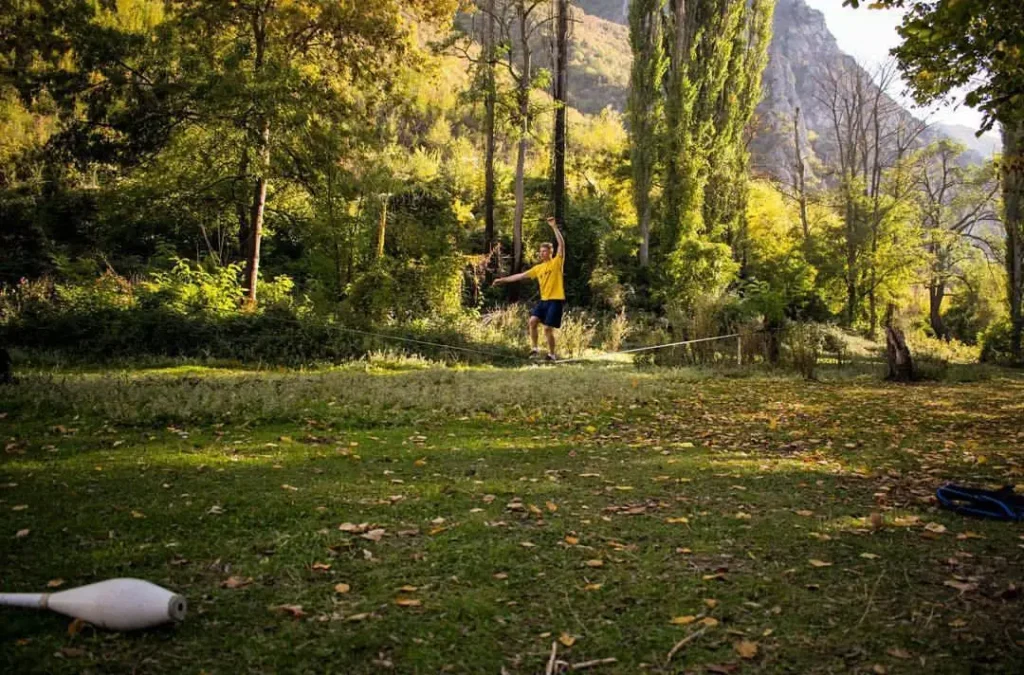
Can Slacklining Actually Improve Focus and Mental Calm?
I don’t use the word meditation loosely. I’ve tried sitting meditation and it never stuck. Slacklining stuck.
The reason is simple, you cannot walk a slackline when your mind is scattered. If you’re thinking about work, an argument, your phone, whatever, you fall off. The line is a direct feedback mechanism for mental state. Calm mind, still body. Noise in your head, you’re on the ground.
That’s not philosophy. It’s physiology. A 2024 EEG study found that skilled slackliners show faster cognitive processing while actively balancing than while simply standing still, a “facilitation effect” not observed in non-slackliners (Frontiers in Human Neuroscience, 2024). The brain, under the demands of balancing, becomes more efficient, not slower or more stressed.
A 2023 study found that a single 50-minute slacklining session produced significantly faster executive function reaction times compared to a sedentary control group, 686ms vs. 705ms, p=0.013 (Frontiers in Psychology, 2023).
That’s after one session. One. Imagine what consistent practice does over months.
For people who already spend time in flow states outdoors, on a trail, on snow, on a climb, slacklining feels natural. You’re not meditating. You’re just doing something that happens to require your full attention. That requirement is the feature, not a side effect.
I’m confident slacklining improved my performance across MTB, snowboarding, dirt bikes, and bouldering. Not just the physical side. The composure under pressure. The ability to be fully present when the terrain gets demanding.
How Much Does Slacklining Reduce Injury Risk?
The 39% reduction in lower limb injury risk from proprioceptive training (PMC11225257, July 2024) is the number I’d put in front of any action sports athlete.
Mountain bikers blow out ankles on root sections. Snowboarders tear up knees on variable landings. Dirt bike riders take unexpected impacts that send shock through the whole lower body. In every one of those sports, the difference between a session that ends normally and one that ends with a trip to the ER is often a fraction of a second of reaction time and the stability of your ankle and knee joints.
Proprioceptive training and slacklining is one of the most effective forms of it, builds the neuromuscular pathways that fire in that fraction of a second. Your body catches the mistake before it becomes an injury. That’s not a marketing claim. That’s the mechanism these studies are measuring.
If your only goal from slacklining was to reduce your injury rate in your primary sport, that alone would justify owning a line.
Anyone Can Start, Including a 220-Pound Backcountry Skier
One thing that puts people off slacklining is the assumption that you need to already be an agile, light, athletic person. My friend at 6’3″ (190cm) and 220+ lbs (100kg) is proof that isn’t true.
The line doesn’t care about your size. What it cares about is that you pay attention and that you don’t panic. The skill is learnable. The timeline is honest, in my experience setting up lines for dozens of people across park events and sessions, I have never once seen someone step on a slackline for the first time and stand right away. Not once. But with 2-3 sessions of actual practice, most people start to find their footing. That’s the honest timeline.
The setup removes most of the danger. Line at roughly knee height, over grass. If you step off, you step off. You’re not falling from height. There’s no speed, no impact, no edge. Compared to the sports most AFIELD readers are already doing, downhill MTB, backcountry skiing, dirt bikes, slacklining is low-risk by any measure.
The failure mode is just falling off a line that’s knee height over grass. You step off, reset, and try again. That’s the whole risk profile.
How to Get Started with Slacklining
What to buy: If I were recommending one line for a beginner, it would be the Gibbon Jib line 15 meters (49 ft). Worth checking current availability, as product lines change. It’s sold as a beginner trickline, but I actually think it’s better for learning to walk than the Gibbon Classic. The Jib has some bounce and elasticity, which I find easier to adapt to than the stiff, static tension of the Classic line. Both work. The Jib is more versatile.
For other outdoor gear to pair with your setup, browse our best-selling outdoor gear picks for 2026.
Setup: Two trees with enough spacing for the line. knee height is the right starting point. The line should have tension but not be guitar-string tight, let’s save that tension for tricklining.
What to expect in your first sessions: You’ll fall off immediately. That’s normal. The goal for session one isn’t to walk, it’s to get comfortable with the movement of the line and to practice standing on one foot. Session two, you’ll start to feel the stillness window. Session three, most people take their first few steps. Don’t rush it.
One thing I’ll say from years of setting up lines for people, the ones who progress fastest aren’t the strongest or most athletic. They’re the ones who are relaxed. Tension kills your line walking. The calmer you are, the better you do. That’s not a metaphor, it’s mechanical. Tense muscles create more micro-movement, the line oscillates more, and you fall off faster.
Relax. Fall off. Try again.
Frequently Asked Questions
Is slacklining hard to learn?
It’s harder than it looks in the first session, and easier than you’d expect by the third. Nobody stands on the line right away, that’s universal. But 2-3 focused sessions is a realistic timeline to start finding your balance. The learning curve is steep at first and then smooths out quickly as your nervous system adapts.
What muscles does slacklining work?
Every stabilizing muscle in your body, from your feet to your neck. The core gets the most noticeable development, deep spinal stabilizers and obliques that most gym exercises don’t reach. The legs respond significantly too, particularly the smaller stabilizing muscles around the ankle, knee, and hip. After a long session, you’ll feel muscles you forgot existed.
How long does it take to walk a slackline?
Most people start taking steps in 2-3 sessions of genuine practice. Walking a full 15-meter (49 ft) line clean takes longer, weeks to a few months, depending on how often you practice. Progress isn’t linear. You’ll have sessions where nothing clicks and sessions where it suddenly all comes together.
Is slacklining good for athletes?
Yes, directly. A 2025 RCT of 30 NCAA Division I football athletes found slackline balance improvements comparable or superior to conventional balance training (PMC12736567, 2025). The proprioceptive and cognitive benefits transfer to any technical sport requiring dynamic balance, skiing, snowboarding, MTB, bouldering, and more.
What’s the best beginner slackline?
The Gibbon Jib line at 15 meters (49 ft) is my recommendation. It has more elasticity than the Classic line, which I find more forgiving for beginners learning to walk. Check current availability directly through Gibbon or a local distributor, product availability changes. Avoid starting on a line longer than 15 meters (49 ft) until you’ve got the basics down.
Can heavy people slackline?
Absolutely. A friend of mine at 6’3″ (190cm) and over 220 lbs (100kg) slacklines well and has seen dramatic improvements in his backcountry skiing as a result. The line’s width-to-weight ratio works at all body sizes. Setup correctly (proper tree anchors, appropriate tension), slacklines handle the load fine. Size is not a barrier.

Filip Petreski is the founder of AFIELD and a multi-sport outdoor athlete. A two-time national cross-country MTB champion, snowboard instructor, and former dirt bike rider, he writes about the people, gear, and culture worth paying attention to in the outdoor world.